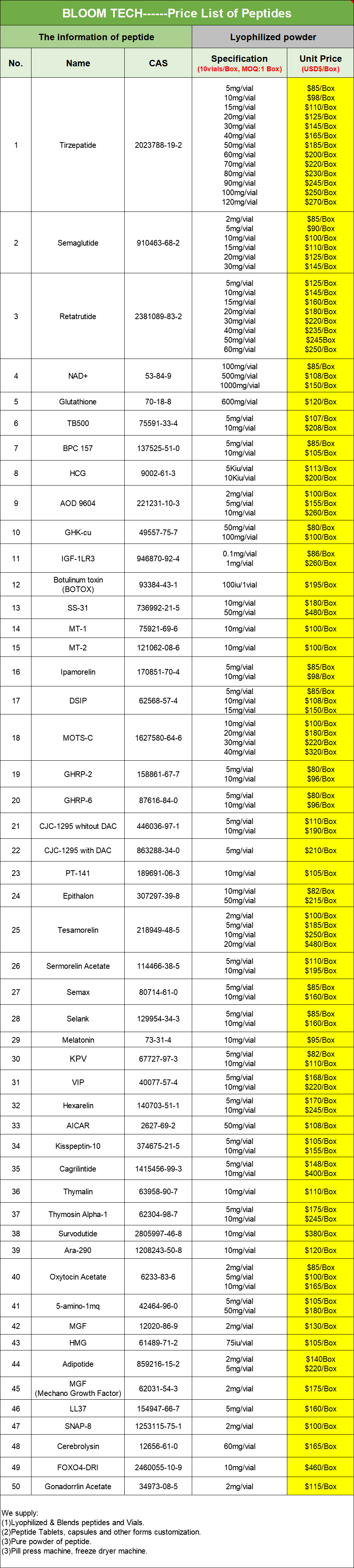
Alloferon-1 is a high-purity bioactive peptide with the CAS No. 347884-61-1, BLOOM product is manufactured under strict quality control protocols, and offer professional guidance for proper storage to extend the product's shelf life for your long-term projects.
Our Products Form



Alloferon-1 COA
 |
||
| Certificate of Analysis | ||
| Compound name | Alloferon-1 | |
| Grade | Pharmaceutical grade | |
| CAS No. | 347884-61-1 | |
| Quantity | 53g | |
| Packaging standard | PE bag+Al foil bag | |
| Manufacturer | Shaanxi BLOOM TECH Co., Ltd | |
| Lot No. | 202601090056 | |
| MFG | Jan 9th 2026 | |
| EXP | Jan 8th 2029 | |
| Structure |
|
|
| Item | Enterprise standard | Analysis result |
| Appearance | White or almost white powder | Conformed |
| Water content | ≤5.0% | 0.46% |
| Loss on drying | ≤1.0% | 0.72% |
| Heavy Metals | Pb≤0.5ppm | N.D. |
| As≤0.5ppm | N.D. | |
| Hg≤0.5ppm | N.D. | |
| Cd≤0.5ppm | N.D. | |
| Purity (HPLC) | ≥99.0% | 99.72% |
| Single impurity | <0.8% | 0.57% |
| Total microbial count | ≤750cfu/g | 80 |
| E. Coli | ≤2MPN/g | N.D. |
| Salmonella | N.D. | N.D. |
| Ethanol (by GC) | ≤5000ppm | 435ppm |
| Storage |
-20°C, protect from light |
|
 |
||
|
|
||

| Chemical Formula: | C52H76N22O16 | |
| Exact Mass: | 1265 | |
| Molecular Weight: | 1265 | |
| m/z: | 1265 (100.0%), 1266 (56.2%), 1267 (15.5%), 1266 (8.1%), 1267 (4.6%), 1267 (3.3%), 1268 (2.8%), 1268 (1.8%), 1268 | |
| Elemental Analysis: | C, 49.36; H, 6.05; N, 24.35; O, 20.23 | |
Antiviral Research Applications

Alloferon-1 can be applied in in vitro cell models such as HEp-2 and KSHV-infected BCBL-1 cell lines, to investigate its regulatory effects on viral lytic cycle-related genes including RTA, K8 and vIRF2. It serves as an ideal tool compound to verify its mechanism of inhibiting calcium influx, downregulating ERK phosphorylation and suppressing AP-1 activation, thus blocking the reactivation and replication of latent herpesviruses like HHV-1 and KSHV. It also supports research on breaking the persistent infection state of herpesviruses and developing novel non-nucleoside antiviral strategies.
Immunopotentiating Antiviral Mechanism Exploration
This peptide is widely used in studies focused on NK cell-mediated antiviral immunity.
It can be adopted to validate how it enhances the perforin/granzyme secretion pathway of NK cells, amplifies the cytolytic activity of immune cells against virus-infected targets, and induces the synthesis of type I interferons. It provides a critical experimental tool for dissecting the crosstalk between antiviral peptide stimulation and host innate-adaptive immune response cascades.
Alloferon-1 can be used in preclinical mouse models of lethal pulmonary influenza infection, HPV-infected cell systems and other RNA/DNA virus challenge assays. It supports comparative research on its antiviral performance against different strains, and helps evaluate its synergistic effect when combined with clinical interferon preparations or direct-acting antiviral drugs, to explore solutions for reducing viral resistance and lowering clinical interferon dosage.


It acts as a lead peptide molecule for structural modification and analogue development. Researchers can use it as the parent template to carry out sequence optimization, stability modification and antiviral activity screening, laying a preclinical foundation for developing new peptide antiviral drugs targeting virus-induced immune dysfunction.
Antitumor Research Applications
Tumor Immunotherapy Mechanism Research
Alloferon-1 is a core tool compound for studying immune cell-based antitumor pathways. It can be used to verify its ability to stimulate the natural cytotoxicity of human peripheral blood lymphocytes and tumor-infiltrating NK cells, clarify its regulatory effect on reversing the immunosuppressive tumor microenvironment, and reveal how it enhances the specific killing effect of immune effector cells against solid tumor and hematological malignancy cells.
Combination Antitumor Strategy Validation
This peptide is suitable for preclinical studies evaluating synergistic antitumor effects. It can be co-administered with chemotherapeutic agents, immune checkpoint inhibitors or tumor therapeutic vaccines in tumor-bearing animal models, to investigate whether it can reduce the required dosage of cytotoxic drugs, alleviate treatment-related immune suppression, and improve the overall response rate of antitumor immunotherapy regimens.


Tumor-Associated Inflammation Intervention Studies
Alloferon-1 can be applied in research linking chronic inflammation to tumor progression. It supports experiments exploring its inhibitory effect on pro-tumor inflammatory signaling axes, such as the NLRP3-Caspase-1-IL-1β pathway in the tumor microenvironment, helping to clarify the mechanism by which it blocks the inflammatory cascade that fuels tumor proliferation, metastasis and angiogenesis.
Antitumor Peptide Drug Lead Optimization
As a naturally derived active peptide with low cytotoxicity, it can be used for in vivo antitumor pharmacodynamic evaluation, pharmacokinetic property testing and structural modification research. It provides a starting scaffold for developing low-immunogenicity, high-stability peptide antitumor candidates, and supports the preclinical assessment of its potential to reduce tumor recurrence and improve long-term survival in tumor model animals.
Anti-Inflammatory and Antitumor Synergy of Alloferon-1
Unlike most conventional antimicrobial peptides that only exert single-target bacteriostatic or immunomodulatory effects, Alloferon-1 demonstrates a unique dual regulatory mechanism that tightly links anti-inflammatory activity with antitumor immune activation. It does not rely on non-specific cytotoxic membrane disruption, but selectively modulates key inflammatory signaling axes such as the NLRP3-Caspase-1-IL-1β pathway to suppress the release of pro-tumor inflammatory factors, thereby cutting off the "chronic inflammation-tumor progression" vicious cycle that fuels tumor proliferation, angiogenesis and distant metastasis.This synergy further differentiates it from common antitumor peptides: while many antitumor peptides directly induce tumor cell apoptosis, Alloferon-1 reshapes the immunosuppressive tumor microenvironment by boosting the cytolytic activity of NK cells and tumor-infiltrating lymphocytes, while concurrently reducing the inflammatory stress that drives tumor immune escape.


In preclinical in vivo models, this combined effect significantly lowers the required dosage of chemotherapeutic agents or immune checkpoint inhibitors, reduces treatment-related inflammatory adverse reactions, and improves the long-term survival rate of tumor-bearing animals. It fills the gap between single-function anti-inflammatory peptides and single-target antitumor peptides, providing a unique tool for research on inflammation-driven tumorigenesis and combinatorial immunotherapy.
Unique Intervention Effect of Alloferon-1 on Antibiotic Resistance
Efficiency leap Precision and stability
Most conventional antimicrobial peptides exert synergistic effects with antibiotics through non-specific mechanisms such as disrupting bacterial membranes to enhance drug penetration, but they rarely directly target the core regulatory pathways of bacterial resistance. Alloferon-1 has a distinct, well-documented mechanism that sets it apart: it specifically downregulates the intracellular nitric oxide (NO) level in drug-resistant bacteria, which in turn inhibits the expression of bacterial efflux pump genes that are critical for antibiotic resistance. This action directly reverses the drug-resistant phenotype of bacteria, restoring the sensitivity of previously resistant strains to conventional antibiotics.


Different from general antibiotic adjuvants that only temporarily enhance antibacterial efficacy, Alloferon-1 can reduce the frequency of bacterial resistance mutation during long-term antibiotic exposure, effectively extending the duration of antibiotic efficacy. In preclinical studies of multidrug-resistant bacterial infections, it has shown the unique ability to lower the clinical dosage of antibiotics while reducing the risk of new resistance development. This characteristic makes it far more valuable than ordinary antimicrobial peptides for research on addressing clinical antibiotic resistance, developing anti-resistance adjuvant regimens, and optimizing veterinary antibiotic reduction strategies.
Temperature Control Specifications
Alloferon-1 is a biologically active peptide with strict temperature sensitivity, and its full-process temperature control system covers storage, transportation and post-receipt handling, to ensure that its structural integrity and biological activity remain fully compliant with quality standards throughout the entire lifecycle.
Long-Term Storage Temperature Requirements
For lyophilized Alloferon-1 powder, different temperature conditions correspond to distinct valid stability periods: Stored at -80°C in a sealed, moisture-proof and light-proof environment, the product maintains full biological activity for up to 2 years. Stored at -20°C under the same sealed and light-protected conditions, the valid shelf life reaches 1 year. For Alloferon-1 pre-dissolved in solvents, it can be stably stored for 6 months at -80°C, and for 1 month at -20°C. Repeated freeze-thaw cycles should be strictly limited to no more than 3 times to avoid peptide chain degradation.


Transportation Temperature Control Standards
For shipments within the continental United States, Alloferon-1 can be transported at room temperature, as the short transit period will not cause significant loss of activity. For cross-regional, transoceanic or high-temperature season shipments, we adopt a full-process cold chain solution: the product is sealed in a light-proof aluminum foil bag, placed in an insulated foam box with ice packs to maintain a constant temperature of 2-8°C throughout the journey. For long-distance shipments exceeding 10 days, BLOOM upgrade to dry ice cold chain packaging to keep the internal temperature below -20°C, eliminating the risk of activity degradation caused by temperature fluctuations.
References
1. Study of alloferon, a novel immunomodulatory antimicrobial peptide (AMP), and its analogues.
2. Alloferon Affects the Chemosensitivity of Pancreatic Cancer by Regulating the Expression of SLC6A14
3.What is Alloferon used for?
4.Alloferon-1 ameliorates estrogen deficiency-induced osteoporosis through dampening the NLRP3/caspase-1/IL-1β/IL-18 signaling pathway.
5.Anti-tumor activity of immunomodulatory peptide alloferon-1 in mouse tumor transplantation model.
6.Method of producing a drug based on oligopeptide alloferon-1, having an antiviral and immunomodulating effect, and prolonged storage medicinal product obtained with its help.
7.What is the mechanism of Alloferon?
FAQ
Q: Will there be any antagonistic effect when Alloferon-1 is used in combination with clinical-grade interferon?
A: No antagonistic effect has been observed in the published preliminary experimental data. The combined use of the two can synergistically enhance NK cell killing activity and reduce the dosage of interferon, thus mitigating the cytotoxic side effects of high-dose interferon.
Q: Can Alloferon-1 be directly premixed with conventional antibiotic stock solutions for use in antimicrobial resistance experiments?
A: The two can coexist stably in sterile aqueous solutions for more than 24 hours without interaction leading to inactivation. Premixing simplifies administration and facilitates high-throughput screening for resistance reversal in 96-well plate susceptibility testing.
Q: How much will the bioactivity of Alloferon-1 decrease after more than 3 freeze-thaw cycles? Can it still be used in formal experiments?
A: Actual test data shows that the product retains ≥85% of its original activity after 5 freeze-thaw cycles. However, it is not recommended for direct use in formal quantitative experiments. The remaining sample can be used for preliminary experimental conditions to explore and avoid affecting the repeatability of formal experimental data due to activity fluctuations.
Q: How should I properly store the product after receiving it?
A: Upon receipt, please immediately transfer the product to a sealed, light-protected location at -20℃. For long-term storage, it is recommended to store it at -80℃ to ensure no activity decay within 2 years. Avoid more than 3 freeze-thaw cycles.
Hot Tags: alloferon-1, China alloferon-1 manufacturers, suppliers, healthy drops liposomal glutathione, Liposomal Glutathione Spray, Nad Lyophilized, Nad Sublingual Drops, Nad Tablet, tb 500 nasal spray