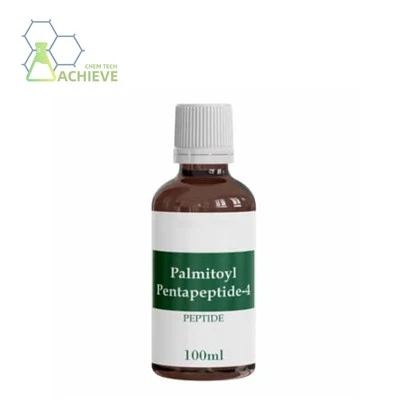
Palmitoyl pentapeptide-4 serum is a classic dermal repairing peptide skincare product dominating the current high-end anti-aging skincare market, with palmitoyl pentapeptide-4 (WrinFix-P5P4) as its core active ingredient. Centered on long-term dermal anti-aging and extracellular matrix repair, this serum features mild potency and broad cutis compatibility. It suits early-ageing, mature and damaged complexions, delivers zero irritation and does not rely on nerve-inhibiting mechanisms, making it safe for long-term use even by sensitive cutis types. Its core strength lies in targeted action on dermal skin cells: by mimicking native human collagen metabolic signals, it activates the cutis's inherent self-repair and regeneration system, fundamentally ameliorating a full spectrum of ageing concerns including collagenous substance depletion, cutis sagging, fine line proliferation, rough texture and facial slackening.
Our products Form


Palmitoyl Pentapeptide-4 COA


Core Mechanism of Action (Matrikine Matrix Signaling Pathway)
Within the family of anti-ageing skincare peptides, distinct bioactive peptides differ fundamentally in their target sites and modes of action, which define their core skincare benefits. The widely recognized Acetyl Hexapeptide-8 targets cutaneous nerve terminals. It blocks nerve-muscle contraction signals to suppress the formation of dynamic facial expression lines, acting as a superficial, instant wrinkle-reducing ingredient that only alleviates dynamic lines without repairing deep dermal ageing damage. In contrast, palmitoyl pentapeptide-4 serum is a prototypical matrikine matrix peptide dedicated to dermal fibril reconstruction. It exerts no influence over the nervous system and does not inhibit muscle contraction. Its primary focus is repairing and remodelling the dermal matrix scaffold.


By activating the body's intrinsic matrix signalling cascade, it reverses deep-level ageing issues including dermal fibril loss, basement membrane laxity and extracellular matrix degradation at the cellular metabolic level, delivering long-lasting anti-ageing repair. It is a deep-acting anti-ageing ingredient specifically formulated to improve static wrinkles, cutis sagging and loss of facial contour definition.
Mimicking Collagen Fragment Signals to Trigger Compensatory Cutis Regeneration Feedback
Human cutis possesses a natural self-regulating feedback loop governing collagenous substance metabolism. Under normal physiological conditions, dermal type I collagen undergoes gradual degradation triggered by ageing, UV radiation, oxidative stress and other stressors, generating specific collagenous substance peptide fragments.
These fragments act as biological signals transmitted to dermal fibroblasts to signal insufficient collagen reserves, thereby initiating the fibroblasts' synthetic repair programme and sustaining dynamic equilibrium of the cutis matrix scaffold. Such collagen fragments with signal-transducing functions are termed matrikine matrix signalling molecules. However, as ageing advances, cutaneous metabolic capacity declines, collagenous substance degradation outpaces neosynthesis, signal transduction efficiency of native collagenous substance fragments drops sharply, and fibroblast activity deteriorates. The cutis fails to synthesize adequate matrix proteins in a timely manner, ultimately leading to dermal thinning, collagen voids, sagging and fine lines.


WrinFix-P5P4 features a palmitoylated KTTKS pentapeptide core sequence sharing high structural homology with bioactive fragments naturally released from human type I procollagen, serving as a synthetic, highly stable matrikine mimetic agent. Upon topical application, it precisely replicates the biological signals of endogenous collagenous substance breakdown fragments and is rapidly recognized by specific receptors on dermal fibroblasts including β1 integrin and CD44. Once cutis cells receive this signal, they mount a stress response indicating massive dermal fibril loss and compromised matrix scaffolding, which in turn triggers compensatory synthetic activity in fibroblasts, reviving dormant and functionally impaired fibroblasts and kickstarting the cutis's innate collagenous substance regeneration process from the root. Unlike conventional skincare actives that rely on exogenous supplementation, this mechanism aligns with native human metabolic logic.
The collagenous substance produced is endogenous homologous bioactive collagenous substance with superior biocompatibility and retention rates, delivering longer-lasting, more stable repair effects without imposing metabolic burden on the cutis.
Activating the TGF-β/Smad Signalling Axis to Drive Multidimensional Synthesis of Dermal Matrix Proteins
After palmitoyl pentapeptide-4 serum activates fibroblasts via mimicked collagenous substance fragment signals, it further binds to specific fibroblast membrane receptors to precisely initiate the downstream core TGF-β/Smad signalling cascade - the pivotal pathway underpinning its capacity to stimulate synthesis of multiple matrix proteins. TGF-β is a master cytokine regulating cutaneous cell proliferation and matrix production in human cutis, while the Smad protein family acts as key signal transducers for this pathway.


Smads rapidly relay signals received at the cell membrane into the nucleus, upregulating expression of a wide array of collagenous substance synthesis-related genes, triggering bulk production of functional dermal matrix proteins, comprehensively remodelling the cutis matrix scaffold, refining texture and lifting cutis firmness.In terms of type I collagen synthesis, this pathway markedly boosts transcription of the type I collagen gene and accelerates its production in the dermis. Type I collagen accounts for over 80% of total dermal fibril, functioning as the core structural scaffold that sustains cutis thickness, facial contour and tautness. Sufficient type I collagen fills dermal fibril voids, alleviating hollow, sagging cutis and superficial static wrinkles caused by collagenous substance depletion, and reinforces the cutis's foundational support structure. For elastic cutis repair, pathway activation efficiently upregulates type III collagen synthesis.
Known as "youth collagen", type III collagen governs cutis smoothness, elasticity and pliability. The plump, hydrated texture of infant cutis stems from abundant dermal type III collagen, which rapidly diminishes with age, resulting in rough, stiff, dull complexions. By persistently elevating type III collagen expression, WrinFix-P5P4 restores smooth, supple cutis and fades dry fine lines.
For stabilizing the cutis's foundational structure, the ingredient specifically stimulates type IV collagen production. Type IV collagen forms the core constituent of the basement membrane that links the epidermis and dermis; the basement membrane is an essential barrier maintaining the cutis's layered architecture and preventing sagging and loss of contour.


UV exposure and chronological ageing directly disrupt type IV collagen structure, triggering basement membrane damage, loose epidermal-dermal adhesion, and subsequent facial slackening, blurred facial contours and cutis drooping.By repairing type IV collagen and reinforcing basement membrane integrity, WrinFix-P5P4 strengthens layered cutis support and fundamentally mitigates sagging and drooping. Beyond this, activation of the TGF-β/Smad cascade simultaneously drives synthesis of fibronectin, elastin and hyaluronic acid (glycosaminoglycans/GAGs). Fibronectin anchors cutis cells and stabilizes matrix architecture; elastin enhances cutis rebound resilience; hyaluronic acid drastically elevates the dermis's water-binding and storage capacity. The synergistic action of these multiple components delivers multi-dimensional anti-ageing outcomes: thicker dermis, hydrated cutis and enhanced firmness.
Downregulating MMP Activity to Suppress Collagen Degradation and Achieve Bidirectional Metabolic Homeostasis
The core essence of cutis ageing lies in metabolic imbalance marked by insufficient collagenous substance neosynthesis and excessive collagen breakdown. Alongside declining collagenous substance synthetic capacity, overactivation of matrix metalloproteinases (MMPs) represents the primary driver of rapid collagenous substance loss. MMPs are hydrolytic enzymes native to human cutis responsible for degrading structural matrix proteins including collagen and elastin. Under normal physiological conditions, MMP activity remains tightly regulated to sustain balanced matrix turnover. However, prolonged UV irradiation, free radical oxidation, sleep deprivation, ageing and external irritants abnormally elevate cutaneous MMP activity, which indiscriminately breaks down all dermal fibril and matrix proteins and accelerates deterioration of the dermal scaffold.


Even small volumes of exogenously supplemented or endogenously generated collagenous substance are rapidly degraded with minimal retention, severely compromising anti-ageing and repair efficacy.
Palmitoyl pentapeptide-4 serum exhibits outstanding collagen-protective properties. By modulating cutaneous cellular metabolism, it significantly suppresses the activity of matrix metalloproteinases (MMPs) and selectively restrains abnormally elevated collagenous substance hydrolysis. It does not interfere with normal physiological matrix turnover, only blocking excessive collagenous substance breakdown, effectively defending against collagen loss induced by UV radiation, oxidative stress and ageing, and reducing depletion of dermal matrix proteins.
Combined with the aforementioned TGF-β/Smad pathway activation that boosts collagenous substance neosynthesis, WrinFix-P5P4 establishes a closed-loop bidirectional anti-ageing model: promoting de novo matrix protein production while inhibiting excessive collagen degradation, completely reversing imbalanced cutaneous collagenous substance metabolism. Distinct from single-action collagen-stimulating skincare ingredients, this dual regulatory mechanism preserves the integrity and stability of the dermal matrix scaffold long-term, allowing newly synthesized collagenous substance to accumulate continuously and gradually. It delivers steady improvements in cutis firmness, elasticity and smoothness, slows intrinsic cutaneous ageing, and fulfils the skincare objectives of long-term anti-ageing and sustained matrix homeostasis.

Discovery History
KTTKS, the core pentapeptide sequence of Pla-KTTKS, was first screened and discovered in the C-terminal propeptide fragment of human type I collagen by the French Sederma research team in the 1990s.
By investigating the natural metabolic mechanism of collagenous substance, researchers identified this core bioactive peptide segment capable of regulating collagenous substance synthesis.
In 1999, to enhance the cutis penetration capacity of the peptide segment, the team performed palmitoylation modification and successfully synthesized Pla-KTTKS, which was commercially named Matrixyl.
In the following decades, academia continuously carried out in vitro cellular experiments and human clinical trials, gradually verifying its multi-functional anti-aging efficacy including anti-inflammation, anti-glycation and collagenous substance promotion. It became the first signal-based anti-aging peptide to realize large-scale commercial application and laid the technical foundation for modern peptide anti-aging skincare.
References
- Peptide Insight. Matrixyl (Palmitoyl Pentapeptide-4)[EB/OL]. 2026.
- Medspot AI. Matrixyl guide: palmitoyl pentapeptide-4, matrikine signaling, and the collagen evidence[EB/OL]. 2026.
- Pepperpedia. Palmitoyl Pentapeptide-4 (Matrixyl)[EB/OL]. 2026.
- Lintner K. Collagen-stimulating peptides for skin anti-aging[J]. International Journal of Cosmetic Science, 2000.
- Choi JH, et al. Dermal stability and in vitro skin permeation of collagen pentapeptides[J]. Biomolecules & Therapeutics, 2014.
FAQ
What does palmitoyl pentapeptide-4 do for cutis?
+
-
Palmitoyl pentapeptide-4 (often known by the trade name Matrixyl) is a signal peptide that visibly plumps and firms aging cutis. By mimicking the breakdown of cutis matrix proteins, it tricks your cutis into boosting the production of essential structural components like collagen, elastin, and hyaluronic acid.
Hot Tags: palmitoyl pentapeptide-4 serum, China palmitoyl pentapeptide-4 serum manufacturers, suppliers, Best Ghk Cu Peptide Injection, Best TB 500 Peptide, delta conotoxin, Nad Peptide Injection, Nad Sublingual Drops, TB 500 Capsules