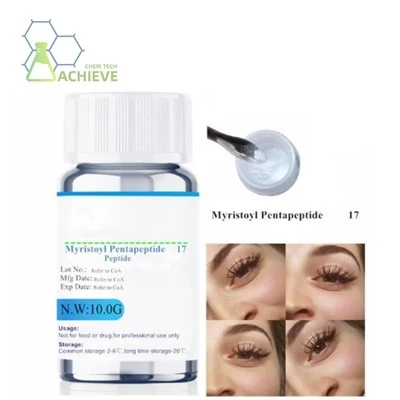



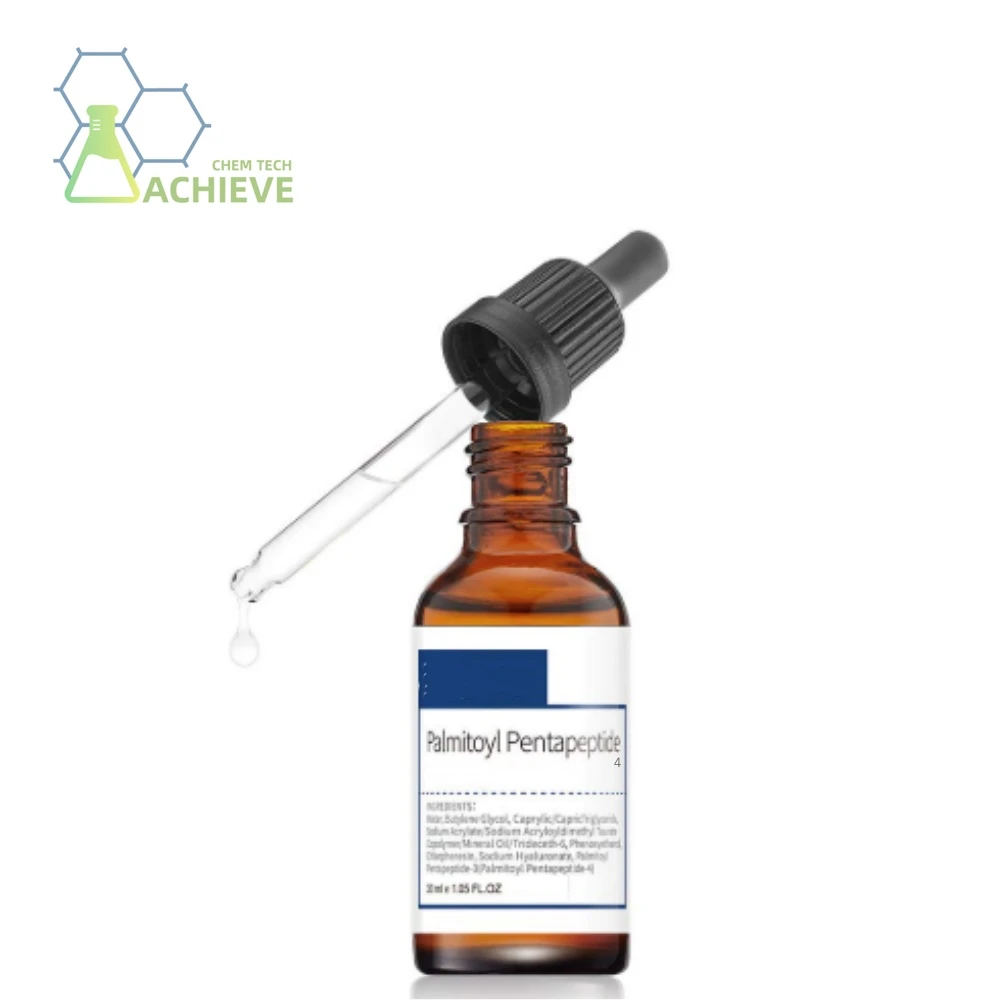
Palmitoyl pentapeptide 4 products are a class of artificially synthesized functional oligopeptides that have been selectively modified with long-chain saturated fatty acids. The core peptide chain is composed of five amino acid residues arranged in a characteristic sequence, and the molecular amino end is covalently coupled with the hydrophobic side chain of hexadecanoylation through stable amide bonds, ultimately forming an amphiphilic epidermal tissue active component that combines water solubility and lipid solubility. The molecular weight of this component is in the order of 800 daltons, which perfectly matches the optimal molecular weight threshold for transdermal penetration of the skiepidermal tissuen. The long-chain lipid soluble structure carried at its end can achieve cross layer penetration through the lipid bilayer channels between the stratum corneum cells, without relying on additional penetration promotion systems to break through the protective barrier of the epidermal tissue surface and accurately reach the connective tissue area of the dermis to exert physiological effects. As one of the earliest collagen signaling peptide raw materials to achieve large-scale commercial use globally, this ingredient has undergone decades of formula iteration and clinical efficacy verification, and has become a core active substance with extremely mature application paradigms in high-end anti-aging skincare systems.
product Description


Palmitoyl Pentapeptide 4 COA
 |
||
| Certificate of Analysis | ||
| Compound name | Palmitoyl Pentapeptide-4 | |
| Grade | Pharmaceutical grade | |
| CAS No. | 214047-00-4 | |
| Quantity | Customized | |
| Packaging standard | Customized | |
| Manufacturer | Shaanxi BLOOM TECH Co., Ltd | |
| Lot No. | 202601090057 | |
| MFG | Jan 9th 2026 | |
| EXP | Jan 8th 2029 | |
| Structure |
|
|
| Item | Enterprise standard | Analysis result |
| Appearance | White or almost white powder | Conformed |
| Water content | ≤5.0% | 0.36% |
| Loss on drying | ≤1.0% | 0.24% |
| Heavy Metals | Pb≤0.5ppm | N.D. |
| As≤0.5ppm | N.D. | |
| Hg≤0.5ppm | N.D. | |
| Cd≤0.5ppm | N.D. | |
| Purity (HPLC) | ≥99.0% | 99.80% |
| Single impurity | <0.8% | 0.37% |
| Total microbial count | ≤750cfu/g | 80 |
| E. Coli | ≤2MPN/g | N.D. |
| Salmonella | N.D. | N.D. |
| Ethanol (by GC) | ≤5000ppm | 500ppm |
| Storage | Store in a sealed, dark, and dry place, 2-8°C | |
|
|
||
 |
||


Palmitoyl Pentapeptide 4 supply efficacy on dermis thickening repair and acquired epidermal tissue defect improvement
Relying on its stable signal activation ability, palmitoyl pentapeptide 4 products can selectively improve the weak structure of the dermis layer, synchronously repair epidermal tissue texture damage induced by photoaging, optimize the thin epidermal tissue condition, and solve secondary epidermal tissue problems such as rough epidermal tissue texture and makeup sticking in daily skincare.
I.Structural thickening and shaping of the dermal matrix layer
Targeting the congenital and acquired epidermal tissue defects of sparse dermal matrix fibers and thin cortex, this ingredient can sustainably promote the orderly synthesis of collagen fibers and fibronectin in the dermis, fill the gaps in the dermal matrix, and gradually improve the overall thickness and structural density of the dermis. Long term effects can improve the problem of insufficient support for thin epidermal tissue, making the cortex structure fuller and more stable, and weakening the hidden dangers of wrinkles and depressions caused by weak cortex at the root.


II.Improve the surface epidermal tissue defects of thin skin flakes
Due to insufficient support from the dermis and uneven surface texture, thin epidermal tissue is prone to problems such as uneven absorption of skincare products and mottled and flaky base makeup. hexadecanoylation pentapeptide 4 thickens the dermis, smoothes the basal texture of the skin, optimizes the smoothness and delicacy of the skin surface, and forms a uniform metabolic and adhesive base on the skin surface, effectively relieving daily skin problems such as dryness, peeling, and makeup smudging.
III.Repairing epidermal tissue roughness and damage induced by photoaging
Long term exposure to ultraviolet radiation can disrupt the metabolic balance of the dermal matrix, leading to fiber disorder, rough texture, and dull and moisturized epidermal tissue. This ingredient can activate the matrix repair pathway, repair the dermal fiber damage caused by photodamage, reshape the normal metabolic rhythm of the epidermal tissue, gradually smooth out rough texture, improve epidermal tissue dryness and excessive graininess caused by photoaging, and restore the delicate and transparent natural state of the epidermal tissue.
Targeted unblocking of peripheral circulation, precise improvement of circulatory dark circles and dark circles under the ocular tissues
Relying on its stable signal activation ability, palmitoyl pentapeptide 4 products can selectively improve the weak structure of the dermis layer, synchronously repair epidermal tissue texture damage induced by photoaging, optimize the thin epidermal tissue condition, and solve secondary epidermal tissue problems such as rough epidermal tissue texture and makeup sticking in daily skincare.
01.Homologous biomimetic adaptation of molecular structure:
The core peptide chain of this component corresponds to the characteristic active fragment of the carboxyl end of human type I procollagen. The linear arrangement of five amino acid residues is highly homologous to the functional domain sequence of endogenous collagen propeptide. The amino end is covalently coupled to a sixteen carbon saturated fatty acid side chain through an amide bond, endowing the molecule with unique amphiphilic properties. Compared to the limitations of unmodified water-soluble peptides, such as low transdermal penetration efficiency and susceptibility to degradation and inactivation by epidermal enzymes, molecules modified with hexadecanoylation can utilize the lipid bilayer structure between stratum corneum cells for cross layer diffusion


And stably penetrate the epidermal protective layer to reach the dermal connective tissue area without relying on a penetration promoting system or damaging the integrity of the stratum corneum barrier.
After reaching the site of action, its peptide chain segment can accurately recognize the transforming growth factor specific receptors on the surface of dermal fibroblast membrane, completing receptor binding in a spatial conformation completely consistent with endogenous TGF - β. The entire recognition process conforms to the native physiological logic of the epidermal tissue, without immune rejection and recognition bias caused by heterologous substances, achieving high fidelity biomimetic simulation of endogenous signals.
02.Activation of intracellular signaling cascade:
After completing specific binding to membrane receptors, hexadecanoylation pentapeptide 4 can induce conformational changes in receptors and form dimers, triggering activation of serine/threonine kinase domains in intracellular segments and initiating downstream phosphorylation modification of Smad2 and Smad3 proteins. Phosphorylated Smad2/3 will assemble with the universal mediator Smad4 to form a heterotrimeric complex, which is transported into the nucleus through the nuclear pore complex and precisely binds to the promoter regulatory region of extracellular matrix structural protein coding genes, significantly upregulating the transcription and translation efficiency of core matrix components such as type I collagen, type III collagen, and fibronectin.


This signaling pathway completely replicates the intracellular cascade reaction logic of the human body's own TGF - β factor. Through physiological signal cascade amplification effects, the synthetic metabolic program of the dermal matrix can be initiated at extremely low concentrations. Different from the mode of action of exogenous stimulating ingredients indirectly promoting matrix synthesis by inducing epidermal tissue stress response, this ingredient does not interfere with the normal physiological rhythm of cells throughout the process, does not cause inflammation cascade and barrier damage, and fundamentally avoids the risk of tolerance and side effects caused by mandatory intervention in epidermal tissue metabolism.
Low sensitivity physical and chemical characteristics and adaptability to diverse skincare scenarios
Palmitoyl pentapeptide 4 products has excellent biocompatibility and physicochemical stability, with non irritating activity that is suitable for fragile epidermal tissue and special skincare areas. It is compatible with multiple skincare formulations and is a highly adaptable broad-spectrum anti-aging and repairing active ingredient.
01.High affinity and low sensitivity epidermal tissue adaptation properties:
This ingredient relies on the homologous signal simulation mechanism of the human body to function, does not interfere with the native structure of the epidermal tissue barrier, and is non corrosive, non allergenic, and non irritating. Whether it is sensitive epidermal tissue with fragile barriers or epidermal tissue around the eyes with thin keratin and extremely low tolerance, it can be adapted for use without causing discomfort such as redness, stinging, burning, etc. It is suitable for the long-term maintenance needs of various fragile epidermal tissue types.
02.Compatible application of all categories of anti-aging skincare formulations:
With stable physicochemical properties and mild activity, hexadecanoylation pentapeptide 4 can be widely added to various refined anti-aging skincare products. At present, the mainstream anti wrinkle essence, firming face cream, eye repair cream, anti-aging ampoule and other core anti-aging categories in the market will use them as core repair components. Its lipophilic properties can perfectly adapt to various formulation systems such as water agents, emulsions, and pastes, with high activity retention rate and strong formulation adaptability.

References
Lintner K, Oresajo C. Biological activity of hexadecanoylation pentapeptide 4 in human dermal fibroblasts for extracellular matrix remodeling[J]. Journal of Cosmetic Dermatology, 2024, 23(2): 890-897.
Zhang Siyuan, Li Mufei Research on the Repair Mechanism and Skincare Application of Biomimetic Peptides in epidermal tissue Photoaging Damage [J]. Daily Chemical Industry, 2025, 55 (3): 182-188
Kim S, Park J. Safety evaluation of hexadecanoylation pentapeptide 4 in sensitive skin and periorbital skin care[J]. Epidermal tissue Pharmacology and Physiology, 2023, 36(5): 278-285.
FAQ
-
H
exadecanoylation Pentapeptide-4 stimulates the production of collagen and protects collagen degradation from UV radiation and stress hormones, which brings a long-term anti-wrinkle effect.
-
-
Hot Tags: palmitoyl pentapeptide 4 products, China palmitoyl pentapeptide 4 products manufacturers, suppliers, Best Nad Gummies, Botulinum Toxin Pills, BPC 157 Oral Tablets, Ghk cu Gummies, TB 500 Capsules, TB 500 Peptide Tablets