

Palmitoyl tetrapeptide-7 serum is a biomimetic peptide skincare essence featuring palmitoyl tetrapeptide-7 (Pal-GQPR-OH) as its core active ingredient. It represents one of the mainstream signal peptide skincare products in the current anti-aging and skin repair segment. Its core active molecule is formed by covalently bonding a palmitic acid hydrophobic chain with the tetrapeptide sequence Glycine-Glutamine-Proline-Arginine (GQPR). This dual structure balances lipophilic penetration and biological signaling activity, effectively resolving a longstanding industry challenge: ordinary water-soluble peptides struggle to penetrate the stratum corneum and exhibit low bioavailability.
In recent years, this ingredient is no longer limited to facial skincare applications; it has expanded into emerging sectors including head skin anti-aging and hair follicle repair. Thanks to its stable and mild properties, it has become a core additive for non-irritating head skin care products, boasting high research and development as well as application value across the cosmetic raw material industry.
Our Products Form


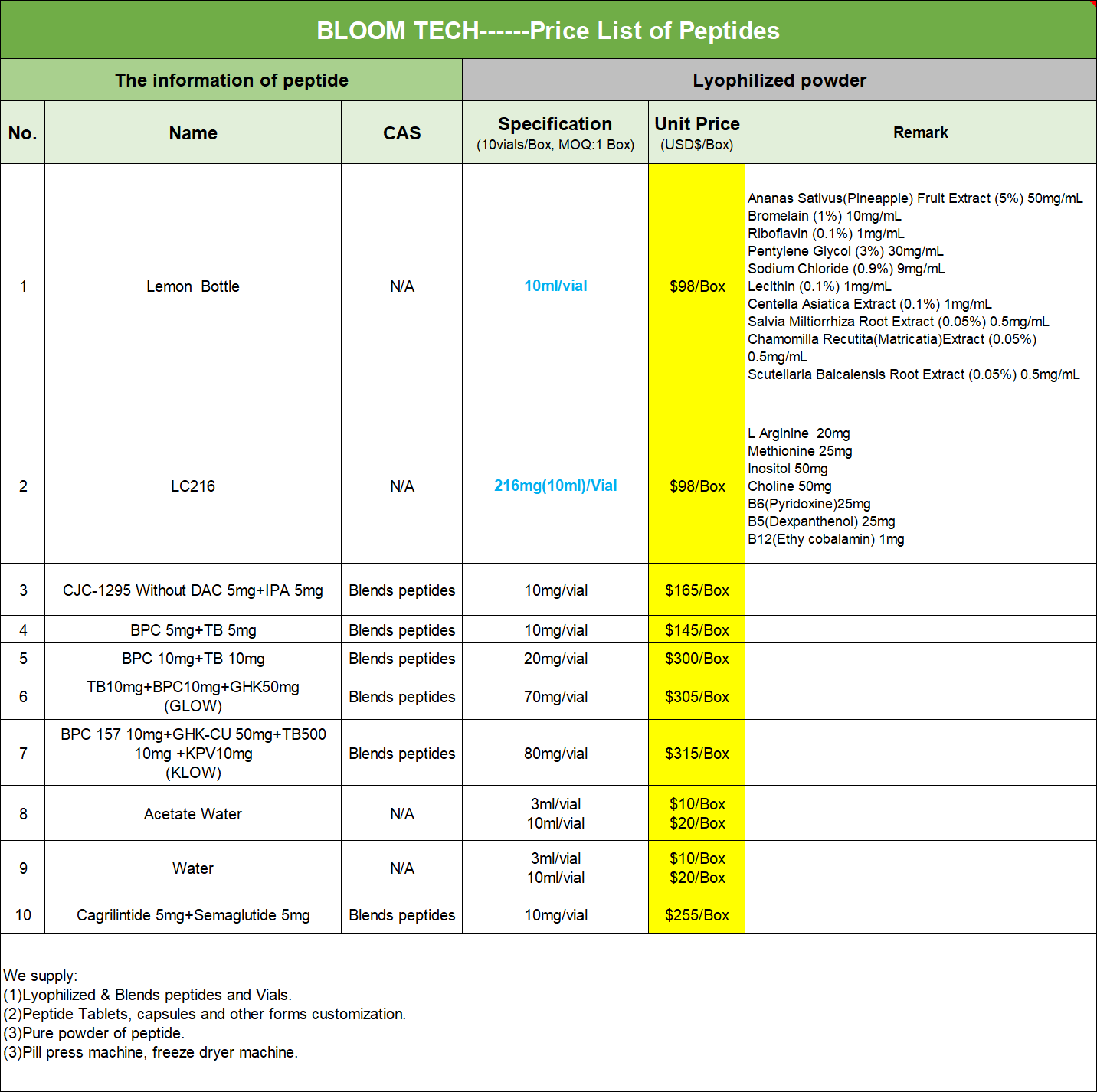

Palmitoyl tetrapeptide-7 COA
 |
||
| Certificate of Analysis | ||
| Compound name | palmitoyl tetrapeptide-7 | |
| Grade | Pharmaceutical grade | |
| CAS No. | 221227-05-0 | |
| Quantity | 65g | |
| Packaging standard | PE bag+Al foil bag | |
| Manufacturer | Shaanxi BLOOM TECH Co., Ltd | |
| Lot No. | 202601090056 | |
| MFG | Jan 9th 2026 | |
| EXP | Jan 8th 2029 | |
| Structure |
|
|
| Item | Enterprise standard | Analysis result |
| Appearance | White or almost white powder | Conformed |
| Water content | ≤5.0% | 0.24% |
| Loss on drying | ≤1.0% | 0.13% |
| Heavy Metals | Pb≤0.5ppm | N.D. |
| As≤0.5ppm | N.D. | |
| Hg≤0.5ppm | N.D. | |
| Cd≤0.5ppm | N.D. | |
| Purity (HPLC) | ≥99.0% | 99.90% |
| Single impurity | <0.8% | 0.44% |
| Total microbial count | ≤750cfu/g | 400 |
| E. Coli | ≤2MPN/g | N.D. |
| Salmonella | N.D. | N.D. |
| Ethanol (by GC) | ≤5000ppm | 560ppm |
| Storage | Store in a sealed, dark, and dry place below 2-8°C | |
|
|
||
|
|
||


| Chemical Formula | C34H62N8O7 |
| Exact Mass | 694.47 |
| Molecular Weight | 694.92 |
| m/z | 694.47 (100.0%), 695.48 (36.8%), 696.48 (6.6%), 695.47 (3.0%), 696.48 (1.4%), 696.47 (1.1%) |
| Elemental Analysis | C, 58.77; H, 8.99; N, 16.13; O, 16.12 |
Core Mechanisms of Action & Emerging Applications
Precise Repair Pathway for the Dermal-Epidermal Junction (DEJ)
The dermal-epidermal junction (DEJ) is a critical basement membrane structure separating the epidermis and dermis, composed of core proteins such as Type IV collagen, Type VII collagen, laminin and nidogen. Analogous to a reinforcing steel mesh for the skin, it facilitates nutrient transport, mechanical support and signal transduction between epidermal and dermal layers.
With aging, ultraviolet radiation, environmental pollution and persistent inflammatory stimulation, the DEJ sustains early damage including structural fissuring, protein loss and basement membrane thinning. These defects trigger premature aging signs: skin sagging, fine lines, epidermal dullness and diminished skin elasticity. Leveraging targeted regulation of cellular signaling, palmitoyl tetrapeptide-7 serum delivers a three-stage DEJ repair cascade: inflammation inhibition, structural protein neosynthesis and basement membrane remodeling, which repairs fundamental structural damage deep within the skin at its source.


Upstream Pathway: Block Chronic Inflammation to Halt DEJ Degradation
Subclinical chronic skin inflammation is the primary trigger of DEJ impairment. External irritants activate the NF-κB inflammatory signaling pathway in keratinocytes and dermal fibroblasts, driving massive secretion of pro-inflammatory cytokines interleukin-6 (IL-6) and tumor necrosis factor-α (TNF-α). These cytokines directly upregulate expression of matrix metalloproteinases (MMPs); among them, MMP-2 and MMP-9 specifically break down Type IV collagen and laminin-key structural components of the DEJ-and compromise basement membrane integrity.
Pal-GQPR-OH competitively binds inflammatory receptors on fibroblasts and keratinocytes, inhibiting NF-κB nuclear translocation and reducing IL-6 secretion. In vitro cellular assays demonstrate this ingredient suppresses IL-6 release in skin cells by over 42%. It severs the inflammation-mediated DEJ degradation chain at the root, protecting existing basement membrane proteins from breakdown and establishing a stable cellular microenvironment for subsequent structural restoration.
Midstream Pathway: Target Fibroblast Activation to Boost DEJ-Specific Structural Proteins
On top of inflammation suppression, Pal-GQPR-OH acts as a biomimetic signaling peptide that specifically stimulates proliferation and differentiation of superficial dermal fibroblasts, selectively elevating synthesis of DEJ-exclusive structural proteins. This distinguishes it from conventional peptides, which only singularly promote production of dermal Type I and Type III collagen.
Tests conducted on 3D human skin in vitro models show that continuous use of the product for 28 days yields a 37% increase in Type VII collagen synthesis, a 41% rise in Type IV collagen production, and a 34% upregulation of laminin V expression. Type VII collagen functions as critical anchoring fibrils linking the epidermis and dermis to mend fractured anchoring structures; Type IV collagen forms the reticular scaffold of the basement membrane, while laminin mediates adhesion between cells and the basement membrane. Combined replenishment of these three proteins thickens thinned basement membranes and repairs microfissures within the DEJ.


Downstream Pathway: Optimize Cellular Adhesion to Rebuild Bilayer Skin Mechanical Connectivity
Comprehensive DEJ repair requires not only replenished structural proteins but also stable adhesion between epidermal cells and the basement membrane. Pal-GQPR-OH simultaneously upregulates expression of tight junction proteins Occludin and ZO-1 in keratinocytes to tighten intercellular epidermal connections, while enhancing adhesion between epidermal cells and the basement membrane. This prevents issues such as epidermal detachment, combination oily-dry skin and fragile skin barriers.
This pathway enables full-chain restoration spanning the dermal basement membrane, intermediate adhesion proteins and epidermal barrier, ultimately alleviating aging manifestations driven by DEJ damage including sagging, dry fine lines and layered skin laxity. Compared with conventional anti-aging serums, it delivers structural anti-aging benefits from deep within the skin outward.
Emerging Applications in Scalp Care
Historically, Pal-GQPR-OH was exclusively deployed for facial anti-aging skincare. Advances in head skin dermatology have revealed the scalp shares highly homologous tissue structure with facial skin, featuring its own scalp DEJ, scalp barrier and hair follicle basement membrane. Head skin aging, hair loss, excess sebum and dandruff are largely tied to chronic head skin inflammation, head skin DEJ damage and disrupted follicular microenvironments.
Endowed with core strengths of mild anti-inflammatory activity, basement membrane repair and zero irritation, palmitoyl tetrapeptide-7 serum has entered premium head skin repair, hair loss prevention and head skin anti-aging product lines as an innovative active ingredient for refined scalp care, with four primary functional dimensions outlined below.


Repair Scalp DEJ to Stabilize Follicle Anchoring
Hair follicle bases embed within the scalp DEJ. Damage to this junction directly weakens follicular anchoring, leading to loose hair roots, fine hair strands and mechanical hair loss-one major driver of aggravated shedding after late nights or UV exposure. Pal-GQPR-OH replicates the facial DEJ repair cascade to restore thinned head skin basement membranes, replenish perifollicular Type IV and Type VII collagen, and reinforce anchoring structures between follicles and the head skin dermis, lowering the risk of hair root detachment.
Unlike traditional anti-hair-loss actives such as minoxidil, which merely stimulate follicle growth, this ingredient improves the living microenvironment of hair follicles to create long-lasting hair retention, without irritant side effects including scalp redness or stinging.
Alleviate Chronic Scalp Inflammation to Improve Seborrheic Scalp Conditions
The vast majority of seborrheic alopecia, dandruff, scalp redness and itching stem from low-grade chronic head skin inflammation. Malassezia overgrowth and pore-clogging sebum continuously activate head skin inflammatory pathways; excess pro-inflammatory cytokines damage follicular epithelial cells, shorten the anagen hair growth phase and accelerate follicular miniaturization.
Pal-GQPR-OH powerfully suppresses IL-6 and TNF-α release from head skin keratinocytes, interrupting the scalp inflammatory cascade and reducing overall head skin inflammation. Clinical head skin trials on human subjects demonstrate that 4 weeks of continuous use of scalp care serum formulated with palmitoyl tetrapeptide-7 serum reduces head skin erythema by 31% and pruritus frequency by 47%. It also curbs inflammation-induced abnormal sebum secretion and gently balances head skin oil and moisture, making it suitable for sensitive scalps and heat/chemically damaged hair post perming and dyeing.

Discovery History
In 1981, an immunology research team isolated the natural tetrapeptide Gly-Gln-Pro-Arg (abbreviated as GQPR, trade name Rigin) from heavy chain fragments of human immunoglobulin IgG. The team verified that this peptide sequence exhibits fundamental activities including immune regulation and inhibition of inflammatory factor release. At that time, it was only used as a peptide for immunological research and had no applications in cosmetics.
In the 1990s, Sederma, a French raw material manufacturer, pioneered a novel research focus on "skin aging induced by chronic inflammation". The company identified that excessive secretion of IL-6 constitutes a core trigger of cutaneous senescence, and set out to modify the GQPR tetrapeptide for topical skincare use. Native water-soluble GQPR could barely penetrate the stratum corneum.
To address this poor transdermal delivery limitation, its R&D team chemically modified the peptide by covalently attaching a hydrophobic palmitic acid alkyl chain to the N-terminus of the peptide backbone, synthesizing its lipophilic derivative Pal-GQPR-OH, which was initially designated Palmitoyl Tetrapeptide-3 under the INCI nomenclature system.
This ingredient completed efficacy assessments via in vitro cell assays and 3D skin models before its official launch in 2003. In 2005, Sederma formulated it with Palmitoyl Tripeptide-1 to launch Matrixyl 3000, a classic anti-aging complex that achieved full commercialization. Between 2012 and 2013, the global cosmetic raw material associations standardized INCI naming conventions, officially renaming the substance Pal-GQPR-OH.
After 2015, the ingredient expanded beyond facial skincare and was gradually adopted for scalp repair applications. Over more than four decades, it has evolved from a basic immunological peptide into a multi-functional cosmetic active raw material, emerging as a benchmark signaling peptide for anti-inflammatory and skin-repairing formulations.
References
- Peptide Journal. Palmitoyl Tetrapeptide-7: Anti-Aging Research[EB/OL]. 2025.
- Kopeptide Biotech. Dual-Efficacy Anti-Inflammatory & Anti-Aging Agent | Research Report on Palmitoyl Tetrapeptide-7 for Sensitive Skin Anti-Aging Raw Material[R]. 2025.
- Uniproma. ActiTide™ PT7 Palmitoyl Tetrapeptide-7 Raw Material Mechanism & Formulation Application White Paper[R]. 2026.
- NINGBO INNO PHARMCHEM CO.,LTD. Palmitoyl Tetrapeptide-7 Formulation Guide & Synthesis Process[EB/OL]. 2026.
- China National Intellectual Property Administration. Anti-Inflammatory Repair Scalp Care Composition Containing Palmitoyl Tetrapeptide-7 and Preparation Method Thereof[P]. CN118021672A, 2024.
Hot Tags: palmitoyl tetrapeptide-7 serum, China palmitoyl tetrapeptide-7 serum manufacturers, suppliers, best nad+ nasal spray, Botulinum Toxin Injection 100iu, Botulinum Toxin Pills, BPC 157 Peptide Capsules, BPC 157 Peptide Powder, Nad Sublingual Drops