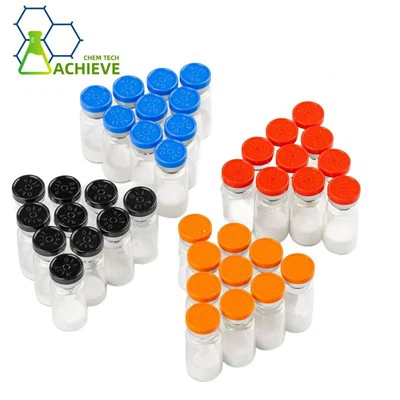



Retatrutide Injection 10 mg is a weight-loss medication that's in development. It works by acting like three gut hormones that help balance appetite and metabolism. This triple-target synergy forms a closed-loop mechanism of "appetite suppression-metabolic acceleration-organ protection."
Kpeptide studies demonstrate that triple activation can improve energy metabolism efficiency by over 30%, reduce adipose tissue by up to 83%, while preserving lean body mass and avoiding muscle loss associated with traditional weight loss approaches.
Products Description


Retatrutide COA
 |
||
| Certificate of Analysis | ||
| Compound name | Retatrutide | |
| Grade | Pharmaceutical grade | |
| CAS No. | 2381089-83-2 | |
| Quantity | 55.0g | |
| Packaging standard | 10g/bag | |
| Manufacturer | Shaanxi BLOOM TECH Co., Ltd | |
| Lot No. | 202510090025 | |
| MFG | Oct 9th 2025 | |
| EXP | Oct 8th 2028 | |
| Structure | N/A | |
| Item | Enterprise standard | Analysis result |
| Appearance | White or almost white powder | Conformed |
| Water content | ≤5.0% | 0.35% |
| Loss on drying | ≤1.0% | 0.26% |
| Heavy Metals | Pb≤0.5ppm | N.D. |
| As≤0.5ppm | N.D. | |
| Hg≤0.5ppm | N.D. | |
| Cd≤0.5ppm | N.D. | |
| Purity (HPLC) | ≥99.0% | 99.90% |
| Single impurity | <0.8% | 0.39% |
| Total microbial count | ≤750cfu/g | 80 |
| E. Coli | ≤2MPN/g | N.D. |
| Salmonella | N.D. | N.D. |
| Ethanol (by GC) | ≤5000ppm | 400ppm |
| Storage | Store in a sealed, dark, and dry place below -20°C | |
|
|
||

Retatrutide TEST REPORT
 |
 |
You can fully rely on BLOOM TECH as your trusted Retatrutide supplier. With 12 years of expertise in fine chemical and pharmaceutical intermediate synthesis, our GMP-certified manufacturing facilities strictly comply with regulatory standards set by the US FDA, EU, Japanese PMDA and CFDA to guarantee consistent, pharmaceutical-grade raw materials.The attached official test reports fully validate our superior product quality: our retatrutide consistently delivers purity far exceeding the 98% pharmaceutical threshold, with test samples reaching up to 99.857% purity, and accurate, stable active ingredient content as confirmed by blind peptide screening and vial content assessment. Beyond premium high-purity peptides, we deliver one-stop full solutions including complete analytical certification documents, customs clearance support and professional technical consultation, ensuring full regulatory compliance, stable supply chains and reliable materials for your research, formulation development and commercial projects.
Obesity and Weight Loss Mechanism StudiesObesity and Weight Loss Mechanism Studies
Dose-response gap filling research
As a transitional dose between the 8 mg and 12 mg groups that have been validated in published phase 2 trials, the 10 mg dose of Retatrutide Injection can precisely supplement the missing data in the existing dose-effect spectrum. It supports researchers to map the complete curve of weight loss percentage, fat mass reduction and lean mass retention over 48 weeks of administration, clarifying the inflection point where weight loss efficacy plateaus as the dose increases.
Triple receptor synergistic mechanism dissection
This dose is designed to produce balanced activation intensity across GLP-1, GIP and glucagon receptors, making it an ideal research tool to distinguish the independent and overlapping effects of each receptor pathway. It helps quantify how much of the total weight loss comes from appetite suppression, elevated hepatic fatty acid oxidation, and adipose tissue lipolysis respectively, compared with single and dual GLP-1-based agonists.
Weight loss response heterogeneity exploration

Researchers use this 10 mg dose cohort to analyze how baseline characteristics including BMI, fasting insulin level and visceral fat percentage influence individual weight loss outcomes. It supports the identification of predictive biomarkers that can stratify high-responders and non-responders, laying a foundation for personalized anti-obesity therapy.
Extra-weight-loss metabolic benefit validation
The 10 mg group provides a moderate, stable weight loss magnitude that allows researchers to dissociate metabolic improvements from pure weight reduction. It helps confirm whether the observed improvements in lipid profiles, waist circumference and insulin sensitivity have independent effects beyond the simple reduction of body weight.
Metabolic Dysfunction-Associated Steatotic Liver Disease (MASLD) Intervention Studies

Precise dose titration for liver fat reduction
This 10 mg dose fills the efficacy gap between the 8 mg and 12 mg groups in existing published MASLD substudy data, which have already demonstrated 81.7% and 86.0% relative liver fat reduction at 48 weeks respectively. It enables researchers to pinpoint the minimum effective dose that can achieve near-maximal liver fat lowering, avoiding unnecessary overexposure to higher doses.
Normal liver fat restoration mechanism research
The 10 mg cohort is used to track the time course and proportion of participants whose liver fat content drops below 5% (the clinical normal threshold). Existing data show that 89% of the 8 mg group and 93% of the 12 mg group reach this endpoint at 48 weeks, and the 10 mg dose can further clarify the dose-dependent pattern of full liver fat normalization.
Fibrosis progression intervention assessment
As a mid-to-high dose with proven sustained metabolic benefits,
Retatrutide 10 mg is applied in long-term extension studies to evaluate its impact on liver stiffness measurements and enhanced liver fibrosis (ELF) scores. It supports investigation into whether the triple agonist can slow or reverse the progression of liver fibrosis, reducing the risk of major adverse liver outcomes such as cirrhosis.
Weight-independent liver protection mechanism exploration
The 10 mg dose provides a carefully calibrated efficacy window that allows researchers to separate liver-specific pharmacological effects from secondary benefits driven by systemic weight loss. It helps verify whether Retatrutide can directly suppress hepatic lipogenesis and enhance hepatic fatty acid oxidation through glucagon receptor activation, independent of changes in body weight.
Exploring Weight Loss Response Heterogeneity
Dose-specific response stratification study
The 10 mg dose of Retatrutide, as a mid-to-high intensity intervention between 8 mg and 12 mg, provides a well-calibrated efficacy window to capture the full spectrum of individual weight loss responses. Meta-analysis data shows that after 24 weeks of treatment, the drug achieves statistically significant odds ratios of 43.34 for ≥5% weight loss, 89.84 for ≥10% weight loss, and 46.93 for ≥15% weight loss compared with placebo, with no significant overall heterogeneity across pooled trials. This 10 mg cohort further dissects the hidden inter-individual heterogeneity that is masked in pooled high-level efficacy statistics.
Baseline phenotype-driven heterogeneity analysis
This research direction uses the 10 mg dose group to systematically map how baseline clinical characteristics influence individual outcomes. Researchers stratify participants by pre-treatment BMI, fasting insulin level, visceral fat ratio, and history of previous weight loss interventions, to quantify how these factors modify the magnitude of weight loss at this specific dose.


It helps identify which patient subgroups are most likely to achieve ≥20% weight reduction, and which subgroups remain non-responders even at this mid-to-high dose.
Biomarker and multi-omics heterogeneity exploration
The 10 mg dose cohort serves as an ideal intervention group for multi-omics research, as it produces consistent metabolic perturbation without extreme weight loss that could confound biomarker signals. Researchers use this cohort to identify circulating metabolites, gut microbiome signatures, and genetic variants that correlate with differential weight loss responses, building predictive models that can distinguish high-responders from low-responders before treatment initiation.
Heterogeneity in weight loss trajectory patterns
Unlike fixed final weight loss endpoints, this research uses the 10 mg dose group to classify distinct dynamic weight loss trajectories over the full 48–72 week treatment period. It identifies subgroups with rapid initial weight loss,
steady gradual decline, early plateau, or partial rebound, and links these different trajectory patterns to long-term safety outcomes, metabolic improvements, and post-discontinuation weight regain risks.
Mechanistic comparison across triple, dual and single agonist responses
The 10 mg Retatrutide group enables direct head-to-head comparison of response heterogeneity against GLP-1 single agonists and GLP-1/GIP dual agonists at equivalent weight loss intensity. It reveals whether the triple receptor agonist mechanism can reduce the proportion of non-responders, or introduce new heterogeneity patterns that are not observed with older generations of anti-obesity medications.
Baseline circulating biomarker screening for response prediction
The 10 mg dose cohort provides a stable, moderate metabolic perturbation that avoids extreme weight loss confounding signals, making it ideal for identifying baseline circulating factors that distinguish high-responders (≥20% total weight loss) from low-responders (<5% total weight loss). Researchers can systematically profile fasting gut hormone levels, adipokine panels, inflammatory cytokines, and lipid metabolites to discover non-invasive predictive biomarkers that can stratify patient response before treatment initiation.
Transcriptomic heterogeneity mapping in adipose and peripheral blood
This specific dose supports transcriptomic profiling of subcutaneous and visceral adipose tissue, as well as peripheral blood mononuclear cells, to uncover distinct gene expression signatures associated with differential weight loss outcomes. It helps identify which pathways related to lipid oxidation, thermogenesis, and appetite regulation are differentially activated in high versus low responders, revealing the molecular basis of inter-individual variability under balanced triple-receptor activation.
Gut microbiome multi-omics association analysis


The 10 mg Retatrutide intervention cohort enables integrated metagenomic and metabolomic analysis of the gut microbiota. Researchers can explore how baseline microbial composition, functional pathways, and microbial-derived metabolites correlate with subsequent weight loss magnitude, and identify specific bacterial taxa that modulate the efficacy of GLP-1/GIP/GCGR triple agonism. This work can uncover microbial signatures that explain a significant portion of the observed response heterogeneity.
Genetic and pharmacogenomic heterogeneity dissection
With large sample sizes in the 10 mg clinical cohorts, researchers can conduct genome-wide association studies to identify genetic variants in GLP-1R, GIPR, GCGR and related metabolic pathways that are significantly associated with differential weight loss responses. This pharmacogenomic research clarifies how genetic background shapes individual sensitivity to each of the three targeted receptors, providing a mechanistic explanation for why some patients fail to achieve meaningful weight loss even at therapeutic doses.
Multi-omics integrative predictive model construction
The consistent efficacy window of the 10 mg dose allows researchers to combine baseline genomic, transcriptomic, proteomic and metabolomic data into a unified multi-omics predictive framework. This integrated model can achieve far higher accuracy in predicting individual weight loss outcomes than single-factor models, laying a solid foundation for future personalized precision dosing strategies for Retatrutide and other triple agonist anti-obesity therapies.
Dynamic multi-omics trajectory tracking during treatment
Beyond baseline profiling, the 10 mg cohort supports longitudinal multi-omics sampling at multiple time points across 24, 48 and 72 weeks of treatment. It captures the dynamic molecular trajectory differences between responders and non-responders, identifying early on-treatment molecular changes that can predict final weight loss outcomes long before the clinical weight difference becomes apparent, enabling early clinical decision-making for dose adjustment or combination therapy.
FAQ
What is the use of retatrutide 10mg?
+
-
Retatrutide is being developed to target multiple metabolic conditions, with its primary uses in obesity management, type 2 diabetes, and fatty liver disease.
What happens after taking retatrutide?
+
-
In our meta-analysis, a higher rate of gastrointestinal-related adverse events, particularly nausea, vomiting, and constipation, in addition to hypersensitivity events was found in patients treated with retatrutide.
How fast will I lose weight on retatrutide?
+
-
One of the standout features of retatrutide is the rapid onset of its weight-loss effects. In the phase 2 trial, participants began experiencing notable reductions in body weight as early as 24 weeks, with the higher-dose groups (8 mg and 12 mg) demonstrating the most pronounced changes.
Is retatrutide better than Ozempic?
+
-
While retatrutide mimics three hormones to support weight loss and blood sugar levels, Ozempic only mimics one. Retatrutide also appears to support more significant weight loss than Ozempic. Research suggests that Ozempic supports an average weight loss of around 6 kg after 40 weeks.
How quickly does retatrutide start working?
+
-
Retatrutide tends to start working within 2 to 4 weeks. In a Phase 2 study, average weight loss in the first four weeks was about 2–5%, depending on the dose
Hot Tags: retatrutide injection 10 mg, China retatrutide injection 10 mg manufacturers, suppliers, Tirzepatide Oral Drops, hgh fragment 176 191 peptide, Semaglutide Gummies, AOD 9604 Powder, AOD 9604 Injection, ghrp 6 tablets