AOD 9604 tablets are a form of formulation with AOD9604 as the core ingredient. it is a synthetic peptide developed based on the C-terminal fragment of human growth hormone (hGH) (amino acids 176-191), initially developed as an anti obesity drug aimed at weight management by regulating fat metabolism. The peptide components are made into tablet form, which is convenient for carrying and taking, and improves the convenience of use. However, the oral absorption of peptide drugs is often affected by the gastrointestinal environment (such as enzymatic hydrolysis, pH), and their bioavailability may be lower than that of injectable drugs. Therefore, some products may improve absorption efficiency through special processes such as microencapsulation and enteric coating, but the specific effects need to be verified in conjunction with clinical data.
Our Product Form
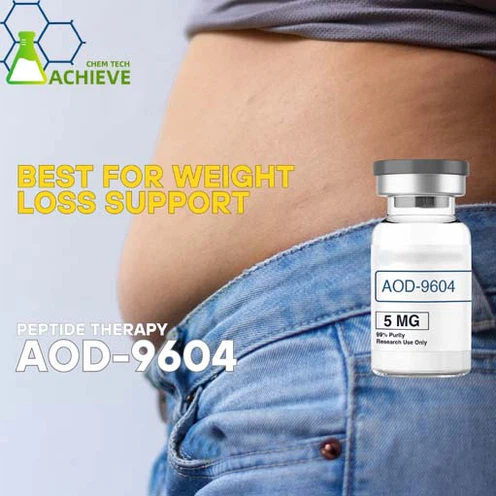




AOD 9604 COA


In the field of obesity treatment, AOD 9604 tablets, as a drug with a unique mechanism of action, is gradually receiving widespread attention. It is designed based on specific fragments of human growth hormone (hGH) and has shown significant effects in regulating steato metabolism and improving obesity related indicators, with relatively small side effects.
1. Accurately activate the fat breakdown signaling pathway
Can specifically bind to β 3-adrenergic receptors on the membrane of adipocytes. This binding process is like opening a door to steato breakdown, triggering a series of signaling responses within the cell. Specifically, it activates the intracellular cyclic adenosine monophosphate (cAMP) - protein kinase A (PKA) signaling pathway. CAMP, as a second messenger, increases its concentration and activates PKA, which in turn phosphorylates and activates hormone sensitive lipase (HSL).


HSL is a key enzyme in the process of steato breakdown, which can catalyze the hydrolysis of triglycerides into glycerol and free steato acids. These free steato acids then enter the bloodstream and are taken up and utilized by other tissues, thereby reducing the accumulation of steato in adipocytes.
In animal experiments, injection into obese rats resulted in a significant increase in cAMP levels in their adipose tissue, enhanced HSL activity, accelerated steato breakdown rate, significant reduction in adipocyte volume, and corresponding weight loss. This mechanism enables it to directly act on adipose tissue, accurately promoting steato breakdown and providing an effective approach for obesity treatment.


In addition to promoting steato breakdown, it also inhibits steato production from the source. On the one hand, it can inhibit the expression and activity of steato acid synthase (FAS). FAS is a key enzyme in the process of steato formation, catalyzing the synthesis of steato acids from acetyl CoA and malonyl CoA, and subsequently synthesizing triglycerides. By downregulating the expression of FAS, the synthesis of steato acids was reduced, thereby reducing the accumulation of steato in the body.
On the other hand, it can inhibit the differentiation of preadipocytes into mature adipocytes. Pre adipocytes are immature cells in adipose tissue that can differentiate into mature adipocytes under certain conditions, increasing the number of adipocytes. By regulating the expression of relevant genes, the differentiation process of preadipocytes is prevented, and the number of adipocytes is controlled. In cell experiments, co culturing preadipocytes with this substance revealed a significant decrease in the proportion of preadipocytes differentiating into mature adipocytes, further demonstrating its role in inhibiting adipogenesis.


3. Regulate metabolic homeostasis and avoid side effects
Unlike complete human growth hormone, AOD9604 has no significant adverse effects on blood glucose and insulin sensitivity while regulating ffattiness metabolism. Complete human growth hormone may cause side effects such as elevated blood sugar and insulin resistance while activating fattiness breakdown, limiting its long-term use in obesity treatment. Due to the specificity of its target, it mainly acts on adipose tissue and does not activate the systemic growth hormone signaling pathway, thus avoiding the occurrence of these side effects.
Clinical studies have also confirmed this. After treating obese patients, their weight and steato mass decrease, but metabolic indicators such as blood glucose, insulin levels, and insulin resistance index remain stable or improve. This indicates that it can regulate steato metabolism while maintaining metabolic homeostasis in the body, providing a safer and more effective treatment option for obese patients.


Through precise activation of the steato breakdown signaling pathway, dual inhibition of the steato production pathway, and regulation of metabolic homeostasis, it has shown great potential in the treatment of obesity. With the continuous deepening of research, it is believed that it will play a more important role in the field of obesity treatment, bringing good news to many obese patients.

Safety assessment: Avoiding traditional growth hormone side effects
Insulin sensitivity protection: validation of normal blood glucose clamp technique
In the obese Zuk rat model, long-term use of AOD 9604 tablets (19 weeks) did not lead to a decrease in glucose infusion rate (GIR), while the intact hGH treatment group showed a 31% decrease in GIR, indicating that AOD9604 does not induce insulin resistance.
Drug Interactions: Evaluation of Metabolic Enzyme Induction/Inhibition
In vitro liver microsomal experiments showed that AOD9604 had no significant effect on the activity of the cytochrome P450 (CYP) enzyme family (CYP3A4, CYP2D6, CYP2C9) (IC50>50 μ M), indicating a low risk of metabolic interactions when used in combination with other drugs.
Safety and tolerability: continuous validation from laboratory to clinical practice
Common adverse reactions: balance between local and systemic reactions
In the clinical trial of AOD9604, the most common adverse reactions were injection site reactions (such as redness, swelling, and pain), with an incidence rate of about 15% -20%, mostly mild and self relieving. Other adverse reactions include headache (5% -10%), nausea (3% -5%), and fatigue (2% -3%), with no significant difference in incidence compared to the placebo group, indicating good overall tolerability of AOD9604.
Monitoring of Serious Adverse Reactions: Long term Safety Data
Long term follow-up studies (up to 2 years) did not find any association between it and serious adverse reactions (such as cardiovascular events, tumors, immune related diseases). It is worth noting that unlike intact hGH, it did not cause growth hormone related side effects such as acromegaly, abnormal blood glucose, or thyroid dysfunction, further supporting its safety as a selective lipolytic agent.
Limitations: Challenges from Research to Clinical Application
Individual Differences in Efficacy: The Influence of Genetic and Metabolic Background
Although significant weight loss effects are observed in most patients, some patients have weaker responses to medication. This may be related to individual genetic differences (such as β 3-adrenergic receptor polymorphism), metabolic status (such as insulin resistance), or lifestyle (such as diet, exercise habits). In the future, precision medicine strategies such as genetic testing and metabolomics analysis are needed to optimize patient selection and improve treatment success rates.


Long term efficacy and rebound risk: weight management after discontinuation of medication
Currently, long-term efficacy data is limited. Some patients experience weight rebound after discontinuing medication, which may be related to the recovery of adipocyte function or metabolic adaptation. In the future, it is necessary to explore combination therapy strategies (such as AOD 9604 tablets combined with lifestyle interventions or other drugs) to maintain long-term weight loss effects.
Regulation and Market Access: Transformation from Research Drugs to Clinical Applications
Although it has shown promising prospects in animal experiments and early clinical trials, it has not yet been approved by mainstream pharmaceutical regulatory agencies (such as FDA, EMA) to be marketed as a weight loss drug. In the future, it is necessary to verify its safety and effectiveness through larger scale and longer period clinical trials, and meet regulatory requirements to promote its transformation from research drugs to clinical applications.

Research Frontiers and Challenges
1. New delivery system
To improve bioavailability, researchers have developed various nano delivery carriers:
Liposomal encapsulation:
Encapsulated in DSPC/cholesterol liposomes, the oral absorption rate is increased to 32%.
Polymer microspheres:
PLGA microspheres achieve drug sustained release, with a sustained release time of up to 14 days.
Transdermal patch:
Combined with chemical penetration enhancers (such as kaempferol), the transdermal absorption rate reaches 15%.
2. Exploration of combination therapy
Combined use with GLP-1 receptor agonists:
In an obese rat model, AOD 9604 (250 μ g/kg) combined with semaglutide (0.1 mg/kg) resulted in a weight loss of up to 28%, significantly better than monotherapy.
Synergistic effect with hyaluronic acid:
In the treatment of osteoarthritis, combined injection can simultaneously improve cartilage metabolism and joint lubrication function.
3. Challenges and controversies
Mechanism of action controversy:
Some studies question whether its lipolytic effect is completely independent of β 3-adrenergic receptors and further verification is needed.
Long term efficacy uncertainty:
Currently, the longest clinical study has only lasted for 12 weeks and lacks long-term follow-up data.
Ethics and Regulation:
The application of sports medicine may lead to fairness disputes, and clear usage norms need to be established.
Hot Tags: aod 9604 tablets, China aod 9604 tablets manufacturers, suppliers, Tirzepatide Oral Drops, hgh fragment 176 191 peptide, Semaglutide Gummies, AOD 9604 Powder, AOD 9604 Injection, ghrp 6 tablets