




Semaglutide peptide 10mg is a revolutionary glucagon-like peptide-1 (GLP-1) analogue. Its 10-milligram dosage marks a significant breakthrough in the fields of obesity management and diabetes treatment. By mimicking the natural GLP-1 hormone in the human body, it can significantly delay gastric emptying, effectively suppress appetite, and promote insulin secretion, thereby achieving strong and sustained weight loss and blood sugar control effects. Compared with the earlier low-dose version, the 10-milligram formulation offers more potent and longer-lasting pharmacological effects, allowing patients to achieve stable blood drug concentrations with only one subcutaneous injection per week. Clinical data have confirmed that this dosage, when combined with lifestyle interventions, can help most patients lose more than 15% of their weight and significantly improve cardiovascular and metabolic indicators. Its rigorous production process ensures the stability and biological activity of the peptide chain, but the dosage should be gradually titrated under the guidance of a doctor to reduce the risk of gastrointestinal adverse reactions, providing a new and highly efficient treatment option for long-term weight management.
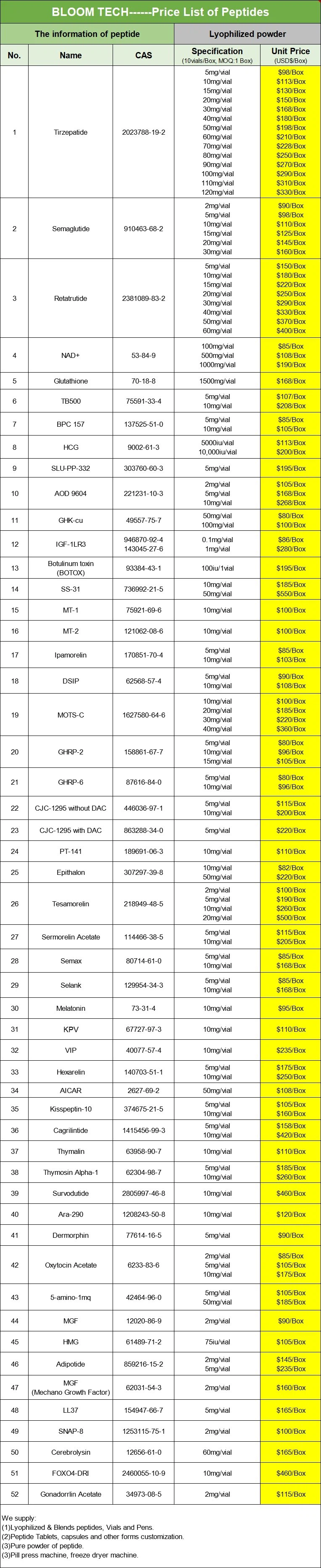
Our Products form



Semaglutide COA
 |
||
| Certificate of Analysis | ||
| Compound name | Semaglutide | |
| CAS No. | 910463-68-2 | |
| Quantity | 25g | |
| Packaging standard | PE bag+Al foil bag | |
| Manufacturer | Shaanxi BLOOM TECH Co.,Ltd | |
| Lot No. | 20250206015 | |
| MFG | Feb.06th2025 | |
| EXP | Feb.06th2028 | |
| Structure | N/A | |
| Item | Enterprise standard | Analysis result |
| Appearance | White powder | Conformed |
| Water content | ≤5.0% | 3.8% |
| Loss on drying | ≤1.0% | 0.35% |
| Heavy Metals | Pb≤0.5ppm | N.D. |
| As≤0.5ppm | N.D. | |
| Hg≤0.5ppm | N.D. | |
| Cd≤0.5ppm | N.D. | |
| Purity (HPLC) | >99% | 99.13% |
| Single impurity | <0.8% | 0.40% |
| Total microbial count | ≤750cfu/g | 80 |
| E. Coli | ≤2MPN/g | N.D. |
| Salmonella | N.D. | N.D. |
| Ethanol (by GC) | ≤5000ppm | 200ppm |
| Storage | Store in a sealed, dark, and dry place below 2-8°C | |
|
|
||


Semaglutide peptide(a synthetic peptide compound) is a derivative of the glucagon-like peptide-1 (GLP-1) receptor agonist. The chemical properties of its 10mg formulation can be explored from aspects such as molecular structure, solubility, stability, and the mechanism of modifying biological activity.
Molecular structure characteristics
Semaglutide is composed of 31 amino acids and has a molecular formula of C₁₈₇H₂₉₁N₄₅O₅₉, with a molecular weight of approximately 4113 Da. Its structure is highly similar to that of natural GLP-1, but it significantly enhances stability through the substitution of two key amino acids:

The 8th position alanine (Ala) is replaced by 2-aminoisobutyric acid (Aib)
The introduction of Aib can resist the degradation by dipeptidyl peptidase-4 (DPP-4). DPP-4 is a naturally occurring enzyme in the body that rapidly breaks down unmodified GLP-1, resulting in a half-life of only 1-2 minutes. However, the stereoscopic structure of Aib hinders the enzyme cleavage site of DPP-4, extending the half-life of Semaglutide to approximately 7 days.
The 34th lysine (Lys) is replaced by arginine (Arg)
The basic side chain of Arg enhances the binding affinity with the GLP-1 receptor and optimizes the molecular charge distribution, further stabilizing the drug's conformation in the body.
In addition, Semaglutide connects a 18-carbon atom fatty acid chain (C₁₈) to the lysine side chain at position 26, achieving covalent binding through a valeric acid connecting arm. This modification enables it to bind to plasma albumin, reducing renal clearance and thus prolonging the duration of action.

Solubility performance
The solubility of Semaglutide is significantly affected by its molecular structure.
Polar groups enhance water solubility: The polar groups in the molecule, such as carboxyl groups (-COOH) and amino groups (-NH₂), can form hydrogen bonds with water molecules, resulting in higher solubility in pure water.
The fatty acid side chain affects the dissolution equilibrium: Long-chain fatty acid side chains are hydrophobic and may reduce the overall solubility. However, through PEG modification (such as short-chain polyethylene glycol connection), the hydrophilicity of Semaglutide is enhanced, balancing the hydrophobic and hydrophilic properties.
pH-dependent dissolution: In acidic or neutral environments (such as a pH 7 aqueous solution), the solubility of Semaglutide can reach 1 mg/mL, making it convenient for preparing injection solutions or oral preparations. However, in extreme pH conditions (such as strong acids or strong bases), its solubility may decrease, and long-term exposure should be avoided.
Stability mechanism
The stability of Semaglutide is achieved through multiple chemical modifications:
Resistance to enzymatic hydrolysis
After Aib replaces the natural Ala, DPP-4 cannot recognize its enzymatic cleavage site, thereby protecting the drug from degradation.
Albumin binding
After the fatty acid side chain binds to plasma albumin, a stable complex is formed, reducing the filtration clearance of the drug in the kidneys. Albumin can also mask the enzymatic cleavage site of DPP-4, further prolonging the half-life.
Temperature and light sensitivity
Semaglutide peptide in powder form needs to be stored at -20℃ to prevent molecular degradation or the formation of impurities. Long-term exposure to high temperature or light may cause the fatty acid chain to break, reducing the drug's activity.
Oxidation stability
The sulfur atoms in the molecule (such as methionine residues) may be oxidized, but such reactions can be effectively inhibited by strict storage conditions (such as avoiding light and moisture).
Chemical basis of biological activity modification
The biological activity of Semaglutide stems from its specific binding to the GLP-1 receptor, and this process relies on the precise design of its chemical structure:

Receptor binding domain
The His-Aib-Glu sequence at the N-terminus of the molecule is the key binding site for the GLP-1 receptor. The introduction of Aib does not disrupt the binding ability of this region; instead, it stabilizes the conformation and enhances the affinity.

Signal transduction regulation
The Arg-Gly-Arg-Gly sequence at the C-terminus is involved in the signal transduction after receptor activation. Its charge distribution is highly consistent with the natural GLP-1, ensuring that the drug can efficiently induce insulin secretion and inhibit glucagon secretion.

Long-term mechanism
The binding of the fatty acid side chain to albumin not only prolongs the half-life but also enables the sustained release of the drug in the body through a "slow-release effect", maintaining a stable blood drug concentration, thereby reducing the dosing frequency (once a week).
The synergistic effect of bioactive modification
Semaglutide peptide 10mg is achieves efficient metabolic regulation through its bioactive modification in the 10mg formulation through multiple synergistic mechanisms. The core lies in the combined effect of amino acid substitution and fatty acid side chain modification, which jointly optimize the drug's stability, receptor affinity, and in vivo circulation time.
Amino acid substitution enhances enzyme resistance and receptor binding
The molecular design of semaglutide incorporates two key amino acid substitutions: the 8th position alanine (Ala) is replaced by α-aminoisobutyric acid (Aib), and the 34th lysine (Lys) is replaced by arginine (Arg). The introduction of Aib blocks the enzyme cleavage site of dipeptidyl peptidase-4 (DPP-4) through steric hindrance, increasing the drug's resistance to enzymatic degradation by approximately 100 times, thereby avoiding the defect of natural GLP-1 being rapidly degraded in the body. The substitution of Arg optimizes the molecular charge distribution and enhances the binding affinity with the GLP-1 receptor, ensuring that the drug can effectively activate the receptor at low concentrations and trigger downstream signal transduction. This dual modification not only prolongs the drug's half-life but also stabilizes the receptor binding conformation, enhancing the specificity of signal transduction.
Fatty acid side-chain modification achieves long-term sustained release
The 26th lysine side-chain of Semaglutide is covalently linked to a 18-carbon fatty acid chain (C18) through a succinic acid linker. This modification enables it to non-covalently bind to plasma albumin, forming a stable complex. Albumin, as the most abundant carrier protein in the body, can protect the drug from enzymatic degradation and renal clearance, and at the same time, through the "sustained release effect", allows the drug to be continuously released in the body. Experimental data show that this modification extends the half-life of Semaglutide to approximately 7 days, supporting a once-weekly administration regimen, significantly improving patient compliance. Moreover, the introduction of the fatty acid side-chain also optimizes the drug's distribution on the cell membrane by increasing its lipophilicity, further enhancing the receptor binding efficiency.
 |
 |
 |
Synergistic effects drive multi-target metabolic improvement
The modification mechanism of semaglutide triggers systemic metabolic network regulation through a single pathway (GLP-1 receptor activation), achieving a "one-shot multiple-benefit" synergistic effect:

Blood glucose regulation
The drug stimulates insulin secretion in a glucose concentration-dependent manner and inhibits glucagon release, achieving precise blood sugar reduction.
Weight management
By activating the vagus nerve and brainstem nuclei, it indirectly regulates the feeding center in the hypothalamus, reducing hunger and delaying gastric emptying, thereby reducing food intake.


Cardiovascular protection
Improving endothelial function, lowering blood pressure, and anti-inflammatory effects jointly reduce the risk of atherosclerosis, significantly lowering the incidence of major adverse cardiovascular events (MACE).
Kidney protection
By lowering blood sugar, blood pressure, and weight, it slows the progression of diabetic nephropathy and reduces proteinuria levels.

Clinical validation and research value
The SUSTAIN series of studies have confirmed that Semaglutide treatment can reduce hemoglobin A1c (HbA1c) by 1.5%-1.8% in patients with type 2 diabetes, reduce weight by 4-6 kg, and simultaneously improve metabolic indicators such as blood pressure and lipid levels. In the field of research, it is widely used as a model molecule to explore the effects of peptide fatty acidation on the biological half-life and receptor affinity, providing experimental ideas for the modification of other peptide molecules. For example, Semaglutide derivatives labeled with fluorescence or radioactivity can precisely determine the receptor binding kinetic parameters, providing quantitative data for drug screening.
FAQ
1. What are the main uses of 10mg semaglutide?
It is mainly used for treating type 2 diabetes and assisting in weight management. On the basis of strict diet and exercise, it can effectively lower blood sugar levels and significantly reduce body weight.
2. How to Use and Store?
It is usually administered by subcutaneous injection once a week. The dosage should be gradually increased from the lowest level as per the doctor's instructions. Unopened vials should be stored refrigerated at 2-8°C; after opening, they can be stored at room temperature but should not be exposed to freezing or direct sunlight.
3. What are the common side effects?
The most common symptoms are gastrointestinal reactions such as nausea and diarrhea, which usually subside as the body adapts. It is important to be aware of the rare but serious risks, such as pancreatitis and biliary disorders. Please consult a doctor before use to assess any contraindications.
Hot Tags: semaglutide peptide 10mg, China semaglutide peptide 10mg manufacturers, suppliers, Tirzepatide Oral Drops, hgh fragment 176 191 peptide, Semaglutide Gummies, AOD 9604 Powder, AOD 9604 Injection, ghrp 6 tablets


