As the body's largest organ, skin serves not only as a physical barrier against external environmental threats but also as a complex ecosystem hosting trillions of microorganisms, including bacteria, fungi, and viruses. Collectively forming the skin microbiome, these microbes interact with skin cells, playing a vital role in maintaining skin health, regulating immune responses, and defending against pathogen invasion. However, modern lifestyles, environmental pollution, excessive cleansing, and the overuse of antibiotics often disrupt the balance of the skin microbiome. This imbalance leads to a reduction in beneficial bacteria and the proliferation of harmful bacteria, triggering various skin issues such as acne, eczema, and dermatitis. Therefore, finding methods to regulate the skin microbiome and maintain its microecological balance holds significant practical importance.
GHK-Cu (Blue Copper Peptide) is a complex formed by the binding of copper ions with the tripeptide glycine-histidyl-lysine (GHK). Since its discovery in 1973, Copper Peptide has garnered significant attention for its exceptional biological activities, including tissue repair, antioxidant effects, and anti-inflammatory properties, finding extensive applications in cosmetic skincare and biomedical fields. In recent years, deepening research on the skin microbiome has prompted exploration into whether GHK-Cu can offer novel benefits for skin health by influencing the composition and function of the skin microbiome. As a potential intervention, GHK-Cu tablets hold promise as a new pathway for regulating skin microbiome balance.
Hot Sale


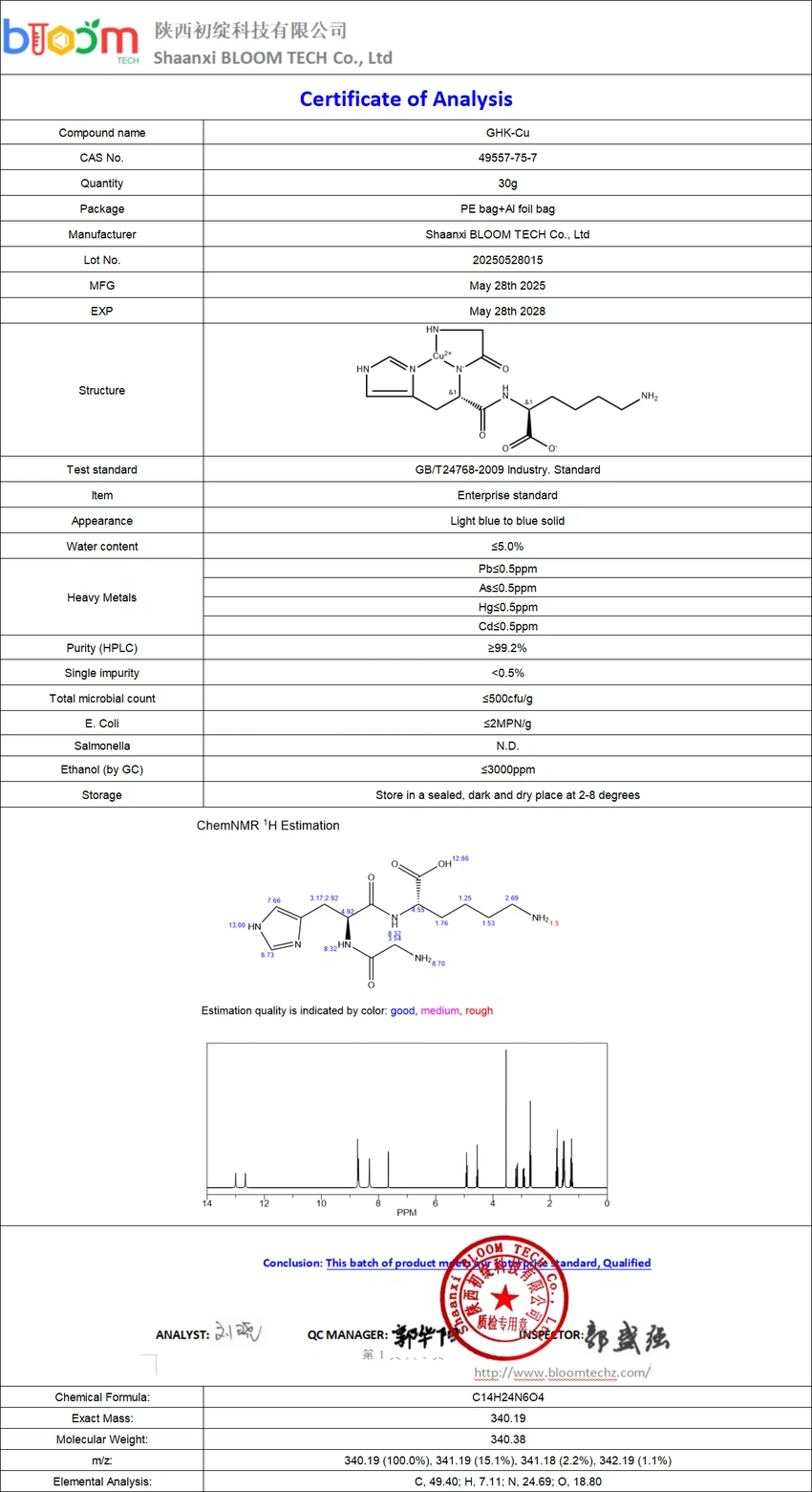
GHK-Cu COA
The Importance of the Skin Microbiome

Maintaining Skin Barrier Function
The skin microbiome is a crucial component of the skin barrier. Beneficial bacteria, such as Staphylococcus epidermidis, inhibit the growth and proliferation of harmful bacteria by competing for nutrients and producing antimicrobial peptides, thereby preventing pathogens from invading the skin. Additionally, the skin microbiome regulates the differentiation and proliferation of keratinocytes, enhancing the skin's physical barrier function, reducing moisture loss, and maintaining skin hydration and elasticity.
Modulating Immune Responses
The skin microbiome interacts closely with the skin's immune system. Beneficial bacteria stimulate skin immune cells-such as dendritic cells and T cells-to generate appropriate immune responses, bolstering skin immunity while preventing inflammatory damage from excessive immune reactions. For instance, certain symbiotic bacteria induce the differentiation of regulatory T cells (Tregs) and suppress the release of inflammatory cytokines, thereby maintaining skin immune homeostasis.


Participation in Skin Metabolism
The skin microbiome participates in various metabolic processes, including lipid metabolism and vitamin synthesis. For instance, Propionibacterium species break down triglycerides in sebum to produce free fatty acids, which exhibit antimicrobial properties and inhibit harmful bacterial growth. Additionally, the skin microbiome synthesizes certain vitamins, such as B vitamins and vitamin K, providing essential nutrients for skin cell growth and metabolism.
Biological Properties
Tissue Repair and Regeneration
Copper Peptide possesses potent tissue repair and regenerative capabilities. It stimulates fibroblast proliferation and migration while promoting the synthesis of extracellular matrix components such as collagen, elastin, and glycosaminoglycans, thereby accelerating wound healing and tissue repair. Research indicates that Copper Peptide increases the expression of basic fibroblast growth factor (bFGF) and vascular endothelial growth factor (VEGF) in irradiated human dermal fibroblasts. This promotes angiogenesis and blood flow to damaged tissues, delivering essential nutrients and oxygen for tissue repair.
Antioxidant and Anti-inflammatory Properties
Copper Peptide exhibits potent antioxidant and anti-inflammatory properties. Copper ions act as cofactors for antioxidant enzymes like superoxide dismutase (SOD), scavenging free radicals and reducing oxidative stress damage to cells. Additionally, Copper Peptide suppresses inflammatory responses by lowering levels of acute inflammatory cytokines such as TGF-β and TNF-α, thereby mitigating tissue injury caused by inflammation.
Antibacterial Activity
Although the antibacterial mechanism of Copper Peptide remains incompletely understood, studies indicate it exhibits inhibitory effects against certain bacteria. Copper Peptide may suppress bacterial growth and reproduction by disrupting bacterial cell membranes or interfering with metabolic processes. This antibacterial activity confers potential applications for Copper Peptide in regulating the skin microbiome.
Mechanism of GHK-Cu Tablets on the Skin Microbiome
Copper Peptide may promote the growth and reproduction of beneficial bacteria by providing essential nutrients or improving their growth environment. For example, copper ions in GHK-Cu act as cofactors for certain enzymes involved in bacterial metabolic processes. Appropriate levels of copper ions can provide essential nutritional support for beneficial bacteria, enhancing their metabolic activity and growth capacity. Additionally, Copper Peptide's antioxidant and anti-inflammatory properties may help reduce skin inflammation, creating a more favorable environment for beneficial bacteria to thrive.


Inhibiting Harmful Bacteria Proliferation
Copper Peptide's antimicrobial activity enables it to directly suppress the growth and reproduction of harmful bacteria. It may inhibit harmful bacteria by disrupting their cell membrane structures, interfering with DNA synthesis, or affecting protein expression. Furthermore, Copper Peptide can enhance the skin's defense capabilities against harmful bacteria by regulating skin immune responses, thereby further inhibiting their proliferation.
Copper Peptide may influence the composition and activity of the skin microbiome by affecting its metabolic functions. For example, it could impact bacteria's uptake and utilization of nutrients, altering the spectrum of bacterial metabolites. Metabolites produced by certain beneficial bacteria exhibit antimicrobial, anti-inflammatory, and immunomodulatory effects. Copper Peptide may enhance the production of these beneficial metabolites by promoting the metabolic activity of beneficial bacteria, thereby improving the skin's microecological environment.

The skin microbiome plays a crucial role in maintaining skin health. As a substance with multiple biological activities, GHK-Cu tablets may regulate the composition and activity of the skin microbiome by promoting the growth of beneficial bacteria, inhibiting the proliferation of harmful bacteria, and modulating the metabolic functions of the microbiome, thereby preserving skin microecological balance. Although current research remains in its preliminary stages, existing findings provide strong support for the application of GHK-Cu tablets in the field of skin health. Future research should delve deeper into the mechanisms by which Copper Peptide influences the skin microbiome, address issues related to its stability and bioavailability, and conduct more clinical studies to fully realize the potential of GHK-Cu tablets in maintaining skin health.
Promoting Muscle Cell Proliferation
Satellite Cell Activation and Myofibrillar Regeneration
Satellite cells serve as the core stem cells for muscle repair, with their activation rate determining the pace of recovery. Copper Peptide enhances this process through the following mechanisms:
Chemokine Regulation: Copper Peptide downregulates CXCL8 (neutrophil chemokine) expression while upregulating CCL2 (monocyte chemotactic protein), promoting more organized immune cell infiltration. In a centrifugal motion model, the peak neutrophil count in the treated group was delayed by 12 hours compared to the control group, while the proportion of M2 macrophages increased by 34%, creating a favorable environment for satellite cell activation.
Epigenetic Regulation: Copper Peptide promotes H3K9 acetylation in the Pax7 gene promoter region by activating histone acetyltransferases (HATs), increasing Pax7 expression by 2.8-fold. In an aged mouse model, Copper Peptide treatment restored satellite cell reserves to youthful levels.
Myotube Fusion and Myofibrillar Hypertrophy
Copper Peptide not only increases cell numbers but also promotes myofibrillar diameter enlargement by regulating myotube fusion:
Troponin Regulation: Copper Peptide upregulates expression of troponin I (TnI) and myosin heavy chain (MHC), proteins fundamental to myofibrillar contractility. In C2C12 myoblasts, Copper Peptide treatment increased TnI expression by 2.8-fold and MHC expression by 1.9-fold.
Enhanced Calcium Signaling: By activating ryanodine receptors (RyR), Copper Peptide increases sarcoplasmic reticulum calcium release, promoting myotube contraction. Electron microscopy revealed an 18% increase in sarcoplasmic tubule diameter and enhanced Z-line structure in treated groups compared to controls. In human trials, strength-trained subjects exhibited a 12% increase in quadriceps muscle fiber diameter after Copper Peptide supplementation, significantly exceeding the 6% increase in the control group.
Suppression of Muscle Inflammation
Reconfiguration of the Inflammatory Cytokine Network:
The inflammatory response following exercise exhibits duality: moderate inflammation promotes repair, while excessive inflammation leads to fibrosis. Copper Peptide achieves balance through precise regulation of inflammatory cytokines:
Pro-inflammatory Factor Suppression: In an LPS-induced macrophage inflammation model, Copper Peptide reduced TNF-α secretion by 67% and IL-6 by 53%, demonstrating efficacy comparable to dexamethasone (10μM) without glucocorticoid side effects. This mechanism involves inhibiting the NF-κB pathway and lowering IκBα phosphorylation levels.
Anti-inflammatory factor activation: Copper Peptide upregulates IL-10 and TGF-β1 expression, which respectively inhibit neutrophil infiltration and promote collagen deposition. In muscle biopsies from marathon runners, IL-10 levels increased 2.1-fold and TGF-β1 increased 1.8-fold after Copper Peptide tablet administration compared to pre-training levels.
Regulation of Immune Cell Infiltration:
Following muscle injury, neutrophils and M1 macrophages initially infiltrate, followed by M2 macrophages dominating the repair process. Copper Peptide optimizes this process through the following mechanisms:
Macrophage Polarization: Copper Peptide promotes M1-to-M2 macrophage conversion by activating the STAT6 pathway. In vitro experiments showed that 100 nM Copper Peptide increased expression of the M2 macrophage marker CD206 by 4.1-fold and ARG1 by 3.7-fold.
Extracellular Matrix Remodeling: Copper Peptide upregulates proteoglycan expression (e.g., decorin) and inhibits TGF-β1-induced fibrosis. In a rat ischemia-reperfusion injury model, treated groups exhibited a 41% reduction in collagen deposition compared to controls, with a 28% improvement in muscle contractile force recovery.
Frequently Asked Questions
Does GHK-Cu require a prescription?
+
-
This product is available by prescription from a 503A compounding pharmacy. Compounded GHK-Cu is not an FDA-approved drug product; instead, clinicians sometimes prescribe it when they judge that its potential benefits-such as promoting a healthier scalp environment-could outweigh theoretical risks in selected patients.
Does GHK-Cu build collagen?
+
-
GHK-Cu increases the production of glycosaminoglycans (GAGs) in fibroblasts, stimulating the synthesis of chondroitin sulfate (CS) to accelerate the production of collagen. It is hypothesized that different cellular pathways are engaged to stimulate gene expression such as TGF-β and TIMPs pathways.
What are the 5 signs that collagen is working?
+
-
It gives your body the best chances to maximise the benefits of collagen supplements. Improved skin hydration and elasticity, fewer fine lines, stronger nails, thicker, shinier hair and a more, radiant complexion are one of the key 5 signs collagen is working.
Hot Tags: ghk-cu tablet, China ghk-cu tablet manufacturers, suppliers, Botulinum Toxin Injection 100iu, Nad Capsule, Nad Peptide Injection, Nad Tablet, BPC 157 Peptide Cream, BPC 157 Peptide Capsules