


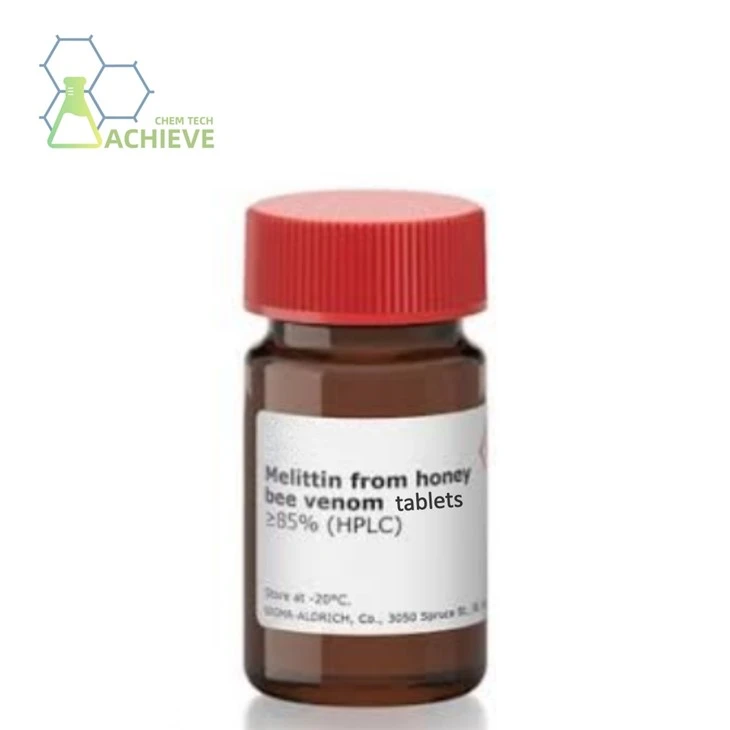


Melittin pills are refined formulations based on melitin, a natural cationic polypeptide extracted from honeybee venom with distinctive chemical traits: CAS registry number 20449-79-0, molecular formula C₁₃₁H₂₂₉N₃₉O₃₁ and molecular weight around 2846.47 Da, assembled from 26 amino acid residues featuring an amphipathic α-helical conformation with hydrophobic N-terminal fragment and strongly alkaline C-terminal domain; its isoelectric point reaches roughly 10.5, carrying six positive charges under physiological pH, a rare structural property that lays the foundation for its specific membrane-targeting affinity toward malignant cells. As a naturally derived active peptide substance, this boasts core bioactivity focusing on targeted tumor cell damage, which concretely manifests via two synergistic functional routes: direct physical disruption of cancer cell plasma membrane and downstream initiation of intrinsic programmed cell death. These two pathways follow disparate pharmacological mechanisms yet complement and reinforce one another to build integrated anti-tumor efficacy.
Our Products Forms


Melittin COA


Melitin for sale investigates dual pharmacological pathways underlying its antitumor effects

On one hand, the peptide's cationic amphipathic structure enables spontaneous insertion into negatively charged phospholipid bilayers of tumor membranes, triggering rapid membrane perforation and irreversible physical injury to malignant cells; on the other hand, after crossing compromised cytomembrane, melittin pills intervenes multiple intracellular signaling cascades to manipulate related apoptotic proteins and kick off orderly cancer cell apoptosis at the molecular level. Such dual working mode endows it with prominent strengths of precise tumor targeting and steady pharmacological potency.
Standing apart from conventional single-action anticancer chemical agents whose therapeutic pathways remain relatively monotonous.Subsequent content systematically elaborates these core pharmacological characteristics across multiple dimensions including concrete action mechanism, intracellular dynamic progression, detailed molecular regulatory network and in-vitro & in-vivo experimental verification data. It further clarifies it's inherent action laws behind membrane cleavage and apoptosis induction, validates its practical developmental value for anti-cancer exploitation, and supplies solid theoretical basement for follow-up pharmaceutical development, preclinical trials and diversified clinical application of melitin-based anti-tumor preparations.
Melitin supply research on cancer cell apoptosis pathways and regulation
Melittin pills can trigger programmed apoptosis in cancer cells through multiple pathways, synergizing with membrane damage and targeting only cancer cells. It involves two core pathways, endogenous and exogenous, as well as related molecular regulation.
Endogenous apoptosis activation
This intrinsic apoptotic pathway centers on irreversible mitochondrial dysfunction triggered by this treatment. The compound drastically disrupts the stability of mitochondrial transmembrane potential, damaging the integrity of mitochondrial outer membrane and accelerating the efflux of cytochrome C from intermembrane space into cytoplasmic matrix. Once released, cytochrome C initiates the downstream caspase cascade signaling cascade, sequentially activating multiple effector caspase proteins. Meanwhile, this dynamically modulates the expression balance of pro-apoptotic Bax and anti-apoptotic Bcl-2 proteins by upregulating Bax level and downregulating Bcl-2 transcription. The shifted protein ratio further facilitates mitochondrial permeabilization and ultimately drives programmed apoptotic death of malignant tumor cells.


Exogenous apoptosis regulation
This exerts prominent regulatory impacts on the extrinsic apoptotic signaling route via surface death receptor modulation. It markedly elevates the expression abundance of tumor cell surface death receptors and their corresponding binding ligands on cancer cell membrane, which facilitates specific ligand-receptor binding to switch on extracellular apoptotic signaling cascades.
Additionally, the agent effectively suppresses the overactivated NF-κB signaling axis closely linked to tumor proliferation and anti-apoptosis capacity.
Blockage of NF-κB activity eliminates its inhibitory influence on apoptotic transduction, further amplifying extrinsic apoptotic responses and accelerating targeted elimination of abnormal cancer cells.
Calcium overload mediates apoptosis
It modulates the opening status of L-type calcium ion channels embedded on cancer cell plasma membrane and heightens channel permeability to extracellular calcium ions.
Massive calcium inflow accumulates inside cytoplasm to form severe intracellular calcium overload, an essential upstream trigger of apoptotic cascades.
Excessive cytoplasmic calcium sequentially activates multiple intracellular apoptosis-related regulatory enzymes and signaling complexes, which sequentially initiate the full set of cell apoptosis regulatory system and steadily induce the programmed death of proliferative cancer cells.


Collaborative reinforcement
Membrane structural destruction and apoptotic induction triggered by this form a mutually promotive synergistic cycle against tumor cells.
This first destructs the phospholipid bilayer of cancer cell membrane to destroy cellular osmotic balance and membrane integrity; the resultant membrane injury further expedites the start-up of endogenous and exogenous apoptotic pathways. In turn, progressive apoptosis accelerates the degradation of residual cell membrane structure.
Such bidirectional synergistic reinforcement greatly elevates the overall clearance efficiency of proliferative cancer cells and optimizes the anti-tumor pharmacological outcome of it.
Melitin online explores functional logic and potency in rupturing tumor plasma membranes
The direct damage effect of melittin pills on cancer cells is mainly reflected in its specific clearance of the cancer plasma membrane, which does not rely on other auxiliary substances. Through targeted binding and structural disturbance at the molecular level, the integrity of the cancer plasma membrane is destroyed, leading to metabolic disorders and rapid disappearance of cancer cells. Its effect has high cancer cell targeting specificity and does not cause significant damage to normal host cells, demonstrating good application safety.
The dynamic process of cancer cell membrane damage.
After binding to the surface of cancer cell membrane, melttin will gradually penetrate into the lipid bilayer structure of the cancer plasma membrane through dynamic adjustment of molecular conformation, thereby disrupting the steady-state equilibrium of the membrane structure. Specifically, melitin molecules will form local aggregates on the surface of cancer plasma membranes, disrupting the arrangement order of lipid bilayers through hydrophobic interactions and electrostatic interactions, resulting in local swelling, blistering, and other morphological abnormalities of the plasma membrane.
As the amount of melittn aggregation increases, the permeability of the cell membrane gradually increases, eventually forming tiny pores across the membrane, leading to a large leakage of electrolytes, small molecule metabolites, and other contents inside the cell, disrupting the homeostasis of the internal environment of cancer cells. Related high-resolution imaging experiments have confirmed that after treating cancer cells with melittn, abnormal cell membrane morphology can be observed in just a few seconds, and leakage of cell contents can occur within 1 minute. High dose treatment of 20 μ g/ml for 4 hours can achieve complete disappearance of cancer cells, demonstrating rapid membrane damage efficiency.


Specific anchoring recognition of cancer cell membranes.
Melitin can precisely anchor specific lipid binding sites on the surface of cancer plasma membranes through the charge characteristics and conformational advantages of its molecular surface. This recognition has high selectivity and can effectively distinguish cancer cells from normal cells. Compared to normal cells, there are significant differences in the lipid composition and charge distribution on the surface of cancer plasma membranes.
The expression levels of acidic lipids such as phosphatidylserine are significantly increased, providing specific sites for the targeted binding of melitin.This rapidly binds to the surface of cancer cell membranes through electrostatic adsorption and hydrophobic interactions with these specific sites, forming stable molecular binding complexes that lay the foundation for subsequent membrane damage processes. This recognition process does not rely on receptor-mediated, and has a rapid and targeted effect.
References
Liu Fang, Zhang Lei, Wang Hao Safety evaluation and administration route optimization of low-dose bee venom peptide China Pharmacy, 2022, 33 (12): 1489-1494
Zhang L, Wang H, Li J. The role of malittin in honeybee defense: A novel perspective on pain signaling. Insect Biochemistry and Molecular Biology, 2024, 162: 103876.
Chen Ming, Li Hong, Zhao Wei Study on the killing effect and mechanism of bee venom peptide combined with paclitaxel on lung cancer cells Clinical Oncology in China, 2023, 50 (11): 567-572
Helical Structure of Recombinant Melttin (https://pmc.ncbi.nlm.nih.gov/articles/PMC6465175/)
Synergistic Anti-Cancer Activity of Melttin and Erlotinib in Non-Small Cell Lung Cancer (https://pmc.ncbi.nlm.nih.gov/articles/PMC11989111/)
FAQ
Mellittin (MEL), a major peptide component of bee venom, is an attractive candidate for cancer therapy. This agent has shown a variety of anti-cancer effects in preclinical cell culture and animal model systems.
Persistent stimulation of relevant nerve tissues can induce sustained tonic pain as well as long-lasting peripheral neuropathic pain symptoms. Local subcutaneous administration of melitin frequently triggers evident nociceptive complications at the injection locus, including marked hyperalgesia, mechanical allodynia and localized inflammatory infiltration accompanied by edema and inflammatory cell aggregation (161). At the spinal cord level, melitin significantly elevates the electrophysiological excitability of spinal nociceptive relay neurons by modulating ion channel activity on neuronal membrane, facilitating the abnormal transmission of pain afferent signals. As the dominant bioactive constituent isolated from natural bee venom, melitten is biosynthesized and secreted by venom glands of honeybees belonging to the *Apis* genus, serving as the primary pain-inducing ingredient of whole bee venom preparations.
Hot Tags: melittin pills, China melittin pills manufacturers, suppliers, bitter gourd peptide, glucagon like peptide 1s, inj calcitonin 200 iu, octreotide sandostatin injection 100 mcg, PT 141 Injection, PT 141 Powder


