




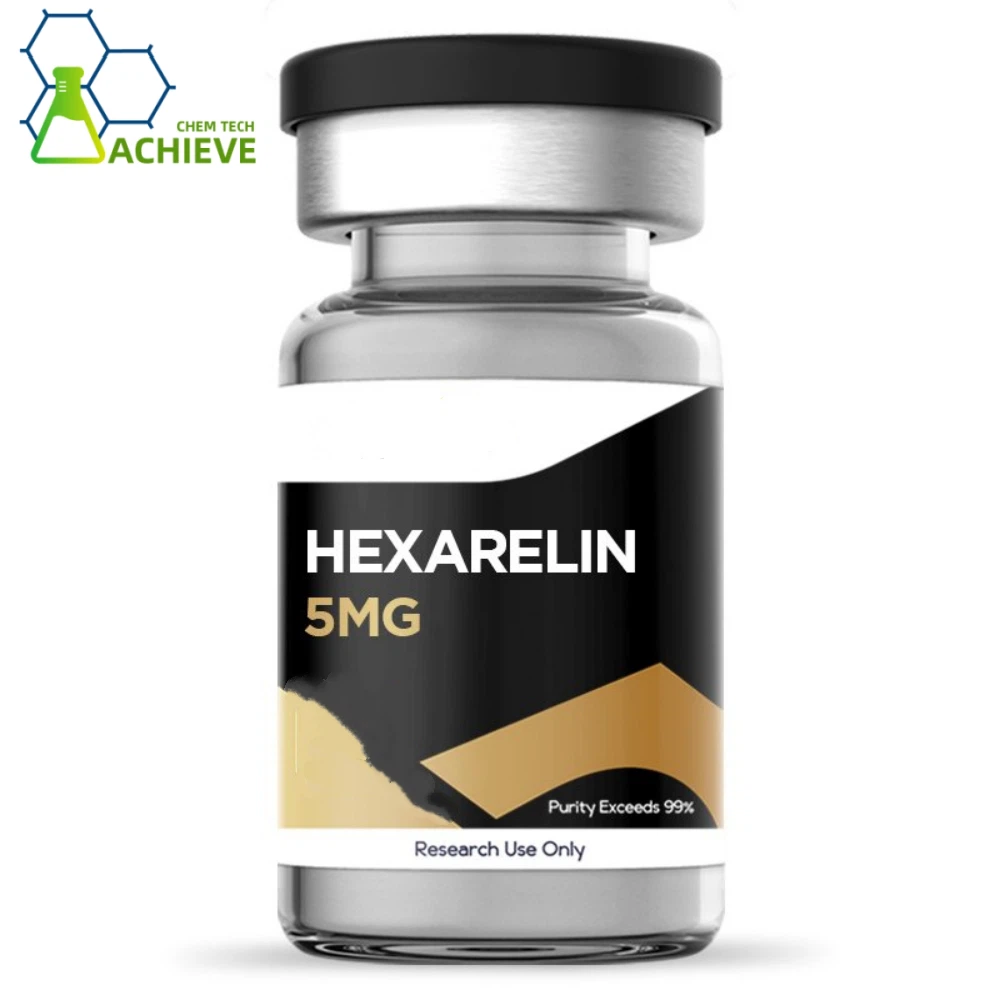
Hexarelin 5mg is a highly active synthetic hexapeptide that acts as a growth hormone secretagogue. Its core features lie in its dual receptor mechanism and high biological efficacy, distinguishing it from ordinary growth hormone-releasing peptides (GHRP). It is encapsulated in a 2ml sterile vial in the form of lyophilized powder, with an actual content verified by a third-party laboratory to be up to 5.34mg. It boasts high purity and strong stability, and requires reconstitution with antibacterial water for use.
Compared to similar peptides, it exhibits no hepatotoxicity, no aromatization reaction, and does not affect the secretion of insulin, sex hormones, etc. It holds significant advantages in research areas such as muscle protection and fat metabolism regulation. Meanwhile, due to its potent growth hormone-releasing properties, it is prohibited by the World Anti-Doping Agency (WADA) for use by athletes and is currently primarily applied in scientific research.
Our Products Form




Hexarelin COA
 |
||
| Certificate of Analysis | ||
| Compound name | Hexarelin | |
| Grade | Pharmaceutical grade | |
| CAS No. | 140703-51-1 | |
| Quantity | 68g | |
| Packaging standard | PE bag+Al foil bag | |
| Manufacturer | Shaanxi BLOOM TECH Co., Ltd | |
| Lot No. | 202512090051 | |
| MFG | Dec 9th 2025 | |
| EXP | Dec 8th 2028 | |
| Structure |
|
|
| Item | Enterprise standard | Analysis result |
| Appearance | White or almost white powder | Conformed |
| Water content | ≤5.0% | 0.62% |
| Loss on drying | ≤1.0% | 0.33% |
| Heavy Metals | Pb≤0.5ppm | N.D. |
| As≤0.5ppm | N.D. | |
| Hg≤0.5ppm | N.D. | |
| Cd≤0.5ppm | N.D. | |
| Purity (HPLC) | ≥99.0% | 99.80% |
| Single impurity | <0.8% | 0.21% |
| Total microbial count | ≤750cfu/g | 105 |
| E. Coli | ≤2MPN/g | N.D. |
| Salmonella | N.D. | N.D. |
| Ethanol (by GC) | ≤5000ppm | 612ppm |
| Storage | Store in a sealed, dark, and dry place below -20°C | |
|
|
||
|
|
||



| Chemical Formula | C47H58N12O6 | |
| Exact Mass | 886.46 | |
| Molecular Weight | 887.06 | |
| m/z | 887.46(50.8%), 888.47(12.6%), 887.46(4.4%), 888.46(2.3%), 889.47(1.2%), 888.46(1.2%) | |
| Elemental Analysis | C,63.64; H,6.59; N,18.95; O,10.82 | |

Major Applications in Improving Glucose and Insulin Tolerance
Based on its unique mechanism of action, Hexarelin 5mg is currently used mainly in scientific research related to abnormal glucose and insulin tolerance. It focuses on the study of obesity‑associated metabolic disorders, non‑obese insulin resistance, metabolic syndrome, and related conditions, providing support for exploring the pathological mechanisms of these diseases and developing potential therapeutic strategies.
Research Application in Obesity-Related Abnormal Glucose and Insulin Tolerance

Obese individuals often present with metabolic abnormalities including insufficient growth hormone secretion, insulin resistance, and impaired glucose tolerance, and are prone to complications such as type 2 diabetes and hyperlipidemia. Through its dual mechanism, it has become an important research tool in this field.
In studies using the genetically obese Zucker rat model, long‑term administration of Hexarelin (80 μg/kg, subcutaneous injection, twice daily) for 30 days did not significantly increase pituitary growth hormone mRNA levels or plasma IGF‑I concentration in obese rats. However, it effectively regulated lipid metabolism and significantly reduced plasma cholesterol levels, indirectly improving the disordered glucose and insulin metabolic status.
Although a mild elevation in insulin and blood glucose levels was observed in obese rats in this study, its core value lies in confirming the regulatory potential of Hexarelin in obesity‑related metabolic abnormalities, providing a basis for subsequent optimization of dosing regimens and exploration of action targets.
In addition, ectopic fat deposition (e.g., in the liver and muscle) caused by obesity is key to exacerbating insulin resistance. The product, by activating the CD36 receptor and PPARγ signaling pathway, promotes normal differentiation of adipocytes and reduces ectopic fat accumulation, thereby alleviating insulin resistance and improving glucose tolerance. Current studies mainly focus on the effects of the product on glucose uptake and insulin signaling in animal models of obesity, providing important evidence for research into potential therapeutic targets for obesity‑related metabolic diseases.

Research Application in Non‑Obese Insulin Resistance

In recent years, the incidence of non‑obese insulin resistance has gradually increased. Although individuals with this condition have normal body weight, they exhibit abnormal fat distribution (e.g., visceral fat accumulation) and disordered lipid metabolism, leading to impaired glucose tolerance and a high risk of progression to type 2 diabetes. The product has shown promising potential in this field.
Particularly in the non‑obese insulin‑resistant MKR mouse model, intraperitoneal injection of Hexarelin (200 μg/kg) twice daily for 12 days significantly improved glucose and insulin tolerance, reduced triglyceride levels in plasma and liver, corrected abnormal body composition by decreasing fat mass and increasing lean body mass, without causing a marked increase in total body weight.
Studies have shown that the core mechanism by which it improves non‑obese insulin resistance is the regulation of adipocyte differentiation and fatty acid metabolism. By activating the PPARγ receptor, it promotes normal differentiation of white adipose tissue, enhances fatty acid oxidation, and reduces lipid accumulation in the liver, muscle, and other tissues, thereby improving insulin sensitivity and glucose metabolism.
This finding challenges the traditional view that metabolic disorders only occur in obese individuals, providing a new approach and tool for the study of non‑obese insulin resistance and expanding the application scope of the product.

Auxiliary Research on Glucose Metabolic Abnormalities Associated with Metabolic Syndrome

Metabolic syndrome is a cluster of metabolic disorders characterized by insulin resistance, hyperglycemia, hyperlipidemia, and obesity. Its core pathological mechanism is closely related to insulin resistance, and abnormal glucose and insulin tolerance are important clinical manifestations.
By regulating growth hormone secretion and improving fat metabolism, Hexarelin 5mg has been used in scientific research related to metabolic syndrome.
Related studies confirm that the product can elevate growth hormone levels, promote lipolysis, reduce lipid parameters such as triglycerides and cholesterol, improve insulin sensitivity, and alleviate impaired glucose tolerance, thereby helping to ameliorate the core symptoms of metabolic syndrome.
In addition, the cardioprotective effect of it (mediated via the CD36 receptor) can reduce the risk of cardiovascular complications caused by metabolic syndrome. Patients with metabolic syndrome are commonly at high cardiovascular risk, and insulin resistance is a major risk factor for cardiovascular disease. By improving insulin resistance, it indirectly reduces the risk of cardiovascular events, providing multi‑dimensional support for the comprehensive study of metabolic syndrome.

Relevant Research Evidence and Clinical Potential

Currently, studies on it for improving glucose and insulin tolerance are mainly focused on animal experiments and early clinicalinvestigations. Although it has not yet been used in large‑scale clinical practice, several studies have confirmed its potential value, laying a foundation for subsequent clinical translation.
At the animal experimental level, in addition to the aforementioned studies in obese Zucker rats and non‑obese MKR mice, multiple investigations have further validated the metabolic regulatory effects of Hexarelin. For example, in a study presented at the 11th Asia‑Pacific Congress on Diabetes, long‑term treatment (2 weeks) with Hexarelin in non‑obese MKR mice with type 2 diabetes significantly improved glucose and insulin tolerance. The mechanism was closely related to activated fatty acid metabolism, enhanced adipocyte proliferation, and increased insulin sensitivity, confirming the regulatory potential of Hexarelin in diabetes‑associated metabolic disorders.
Furthermore, studies have found that Hexarelin can improve dyslipidemia by modulating PPARγ receptor activity, thereby alleviating insulin resistance. This mechanism provides clear theoretical support for its application in metabolic diseases.
In early clinical exploration, it has been mainly used in short‑term intervention studies in subjects with metabolic disorders. Results showed that regular administration significantly improved insulin sensitivity and oral glucose tolerance test (OGTT) outcomes, with no serious adverse events reported. Only a few subjects experienced mild symptoms such as increased appetite or limb numbness, which resolved rapidly after drug discontinuation. This indicates that it has a certain safety and efficacy profile for metabolic regulation in humans. However, due to the small sample size and short follow‑up duration in current clinical studies, its long‑term safety and clinical efficacy still require further validation.
Compared with similar peptide agents (e.g., Ipamorelin, Tesamorelin), the advantage of Hexarelin 5mg lies in its dual‑receptor mechanism: it not only potently stimulates growth hormone secretion but also directly modulates metabolic‑related receptors, leading to a more comprehensive improvement in glucose and insulin tolerance.

Nevertheless, it has certain limitations: long‑term use may increase prolactin and cortisol levels, which could affect metabolic regulation. Therefore, dosage and treatment duration must be strictly controlled in research.

Key Precautions in Application

Since the product is currently used mainly for scientific research purposes and has not been approved by the FDA for clinical therapy, its application must strictly follow research protocols, with particular attention to the following precautions to ensure safety and scientific validity.
First, strictly control dosage and administration. It is a lyophilized powder with high purity and strong activity. It must be reconstituted with bacteriostatic water and administered subcutaneously. The recommended research dose is 50–150 mcg per administration, 1–2 times daily, with fasting administration (no food 1 hour before and after dosing) for optimal effect, avoiding interference from food on absorption and efficacy. The recommended duration for long‑term administration is no more than 16 weeks, followed by a 4‑week washout period to avoid hormonal disturbances (e.g., elevated prolactin and cortisol) and reduce adverse reactions.
Second, monitor adverse reactions. Most adverse reactions of it are mild and transient, including increased appetite, limb numbness, edema, and headache, which usually resolve spontaneously without specific treatment. However, long‑term use may increase prolactin and cortisol levels, potentially causing anxiety or sleep disturbances. Therefore, regular monitoring of hormone levels, blood glucose, insulin, and other parameters is required during research, with timely adjustment of the dosing regimen.
Third, standardize storage and handling. It lyophilized powder should be stored refrigerated at 2–8 °C, protected from direct sunlight and high temperatures. Reconstituted solution must be used within 24 hours to prevent degradation and loss of activity. In addition, strict aseptic technique must be followed during administration to avoid injection‑site infection.

FAQ
Does hexarelin burn fat?
+
-
Collectively, our results showed that hexarelin increased pulsatile GH secretion, reduced fat mass, and improved the lipid profile without compromising glucose metabolism in MKR mice.
What are the benefits of hexarelin peptide?
+
-
Hexarelin is a powerful Growth Hormone-Releasing Peptide (GHRP) that stimulates the pituitary gland to increase natural growth hormone (GH) production, enhancing muscle growth, fat loss, and tissue repair. It significantly improves recovery times, boosts physical strength, supports bone density, and offers potential cardioprotective benefits.
How long does it take to see results from Hexarelin?
+
-
Hexarelin is a rapid-acting growth hormone secretagogue, with significant increases in growth hormone levels typically observed within 30 to 40 minutes of administration, Springer Nature Link and Journal of Endocrinology. Visible physical changes and therapeutic benefits, such as improved body composition or skin quality, generally become noticeable within a few weeks, with optimal results developing over 3 to 6 months.
Hot Tags: hexarelin 5mg, China hexarelin 5mg manufacturers, suppliers, salcatonin injection, intranasal desmopressin acetate, best glp 1 peptide, CJC 1295 NO DAC 2mg, glp1 shot, etelcalcetide structure


