


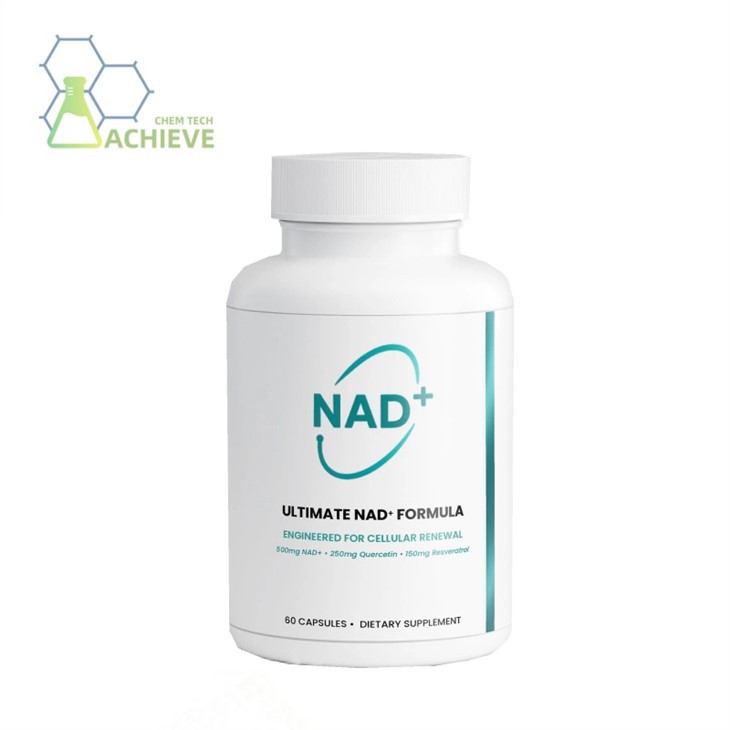


In humanity's quest to combat aging and pursue healthy longevity, maintaining and enhancing cognitive function remains a central concern. As we age, brain function gradually declines, leading to issues such as memory loss, difficulty concentrating, and slowed thinking-all of which significantly impact quality of life. In recent years, NAD+ (nicotinamide adenine dinucleotide), a crucial cellular energy metabolism molecule, has demonstrated significant potential in enhancing cognitive function. NAD+ capsules, as a supplement form, are increasingly becoming a focal point of attention.
Best Selling


Certificate

Technological Surge
NAD is a core coenzyme for cellular energy metabolism, DNA repair, and aging regulation, with its levels significantly declining with age. The scientific community has confirmed that supplementing with precursors (such as NMN and NR) can elevate NAD concentrations in the body, thereby improving mitochondrial function, enhancing insulin sensitivity, and delaying cognitive decline. This discovery has fueled explosive growth in the global NAD capsule market: the top five manufacturers command nearly 80% market share, with products boasting ≥98% purity dominating 93.5% of sales. "Anti-aging" and "energy enhancement" have emerged as the primary consumer motivations.
Technological advancements have further amplified the appeal of NAD capsules, whose development journey can be described as a "history of technological evolution":

Third-generation oral technology: Early NAD oral products had limited efficacy due to degradation by stomach acid and low absorption efficiency. Today, gene editing technology activates NAD synthesis genes, boosting absorption efficiency by 200%. Enteric-coated sustained-release capsules use specialized coatings to bypass gastric acid degradation, releasing NAD at specific intestinal sites for triple absorption rates. Ultra-pure raw materials (e.g., 99.9% pure C9NMN Pro) undergo precision purification to eliminate impurities, extending half-life to 72 hours for sustained efficacy.
The "Instant Effect" of Injection Therapy: For high-net-worth individuals seeking rapid results, intravenous NAD injections have become a popular choice. Within 1-3 hours post-injection, NAD levels surge by 2-3 times, swiftly alleviating fatigue and enhancing cognitive function. Some premium medical institutions even offer customized injection protocols, adjusting dosage and frequency based on individual genetic testing results for precision anti-aging.


Breakthroughs in Combination Therapies: Single-agent NAD supplementation has limitations, prompting scientists to explore combination therapies. Combining NAD with senolytics (ageing cell clearance) technology demonstrated a 36% lifespan extension in mouse studies. Pairing it with stem cell activation technology promotes tissue repair and regeneration. Formulating it with coenzyme Q10 and antioxidants creates an "anti-ageing matrix" that combats ageing from multiple dimensions.
Shadows and Controversies Behind the Halo
However, scientific truth is far more complex than commercial narratives. The "anti-aging myth" surrounding NAD capsules faces growing scrutiny:
Absorption Challenges: Harvard Medical School research reveals that orally ingested NMN/NR must first be converted into nicotinic acid by gut microbiota before being synthesized into NAD by the liver. If an individual's gut microbiota is imbalanced, expensive supplements may prove entirely ineffective. For instance, individuals who have undergone long-term antibiotic use or suffer from intestinal disorders may absorb NAD precursors at less than 30% of normal efficiency.
Potential Risks: A Danish team's study in Nature Cell Biology revealed another side of NAD supplementation: Directly adding exogenous NAD can cause DNA replication damage, halt cell proliferation, and even trigger genomic instability. This finding completely overturns the notion that "more NAD is always better," suggesting long-term excessive supplementation may carry carcinogenic risks.
Individual Variability: Human responses to NAD exhibit significant individual differences. Genetic testing indicates that some individuals, due to mutations in NAD synthase genes, struggle to elevate NAD levels even with substantial precursor supplementation. Conversely, others may experience transient supplementation effects due to accelerated metabolism. This variability challenges the "universal applicability" of NAD capsules.
The Resource Allocation Crisis Under Technological Monopoly
The commercialization of NAD capsules is exacerbating inequality in social resource distribution, pushing the differentiation of lifespan to new extremes.

Price Barriers: From "Luxury Goods" to "Class Symbols"
Currently, the NAD capsule market exhibits a distinct "dual-track system":
Premium Market: Single bottles typically retail between ¥500–2000, with products featuring patented compound ingredients (e.g., PQQ, PS, rosehip extract) commanding even higher prices. For instance, a brand's "Fifth-Generation NAD Capsules" claims to slow aging through a six-tier synergistic mechanism, priced at ¥3000 per bottle and targeting high-net-worth individuals earning over ¥1 million annually. Beyond their premium pricing, these products cultivate scarcity through limited releases and membership exclusivity, further cementing their status as "class symbols."
Mass Market: Low-cost options (e.g., ¥100–300 per bottle) dominate e-commerce channels, yet often suffer from insufficient purity and excessive impurities. Some NAD capsules produced by small workshops fail quality inspections and may contain harmful substances like heavy metals, posing health risks. While seeking low prices, consumers often overlook product quality and safety, falling into the "low-price trap."
This price stratification has made NAD a symbol of "class identity." Research indicates that 65% of purchasers admit taking the capsules primarily for psychological reassurance-"even if the effects are limited, at least I'm taking action against aging." Low-income groups are excluded from this "technological dividend," further widening the gap in healthy life expectancy. For instance, NAD capsule adoption rates reach 30% in high-income communities, while remaining below 5% in low-income neighborhoods.
Technological Monopoly: A Closed Loop from Lab to Supply Chain
Core technologies for NAD+ capsules-such as high-purity raw material extraction, enteric-coated sustained-release technology, and gene-edited formulations-are controlled by a handful of giants. Companies like Geneharbor and Chromadex monopolize NMN production through patent barriers, forcing other manufacturers to pay exorbitant licensing fees. This monopoly not only inflates costs but also hinders technological accessibility:
Exorbitant R&D Costs: Small and medium-sized enterprises struggle to bear R&D expenses, limiting them to low-value-added products. For instance, developing a novel enteric-coated sustained-release capsule requires millions of dollars for clinical trials and process optimization. Lacking sufficient funding, SMEs often resort to traditional technologies, resulting in suboptimal product efficacy.
Upstream Supply Chain Control: Biotechnological fermentation processes for NAD+ precursors (like NMN and NR) are monopolized by a handful of companies, keeping raw material prices artificially high. For instance, NMN raw materials with 99.9% purity cost three times more than standard products. SMEs must settle for lower-purity alternatives, further diminishing product efficacy. This "upstream bottleneck" places SMEs at a competitive disadvantage, hindering their ability to overcome technological barriers.


Geographic Inequality: The "Resource Siphoning" of Global Markets
Consumption of NAD+ capsules exhibits pronounced regional disparities:
North American Market: Commanding 40% of global share, its consumer base primarily consists of high-net-worth individuals seeking "instant anti-aging" effects, with high prevalence of intravenous therapy. Leveraging technological advantages and capital strength, North American companies dominate the global market, extracting excess profits from the Asia-Pacific region through technology exports and capital control.
Asia-Pacific Market: China, Japan, and South Korea hold a 35% share, where consumers prefer oral capsules. However, regulatory policies restrict access, leading some products to enter via cross-border e-commerce with quality risks. For instance, uncertified NAD+ capsules enter China through overseas purchasing agents, posing unguaranteed safety and efficacy risks to consumer health.
European Market: Holding 20% share, European consumers demand rigorous scientific evidence, and regulatory bodies impose stricter scrutiny on NAD+ efficacy claims, resulting in slower market growth. European companies prioritize product safety and compliance, but high regulatory barriers prolong new product launch cycles, hindering rapid market responsiveness.
This geographic inequality concentrates resources in developed nations. For instance, North American companies extract excess profits from the Asia-Pacific market through technology exports and capital control, while local firms are confined to low-end processing, hindering core technology accumulation. Simultaneously, developing countries lag in NAD+ R&D and regulation, failing to effectively protect domestic consumer rights-further exacerbating global health inequalities.
Ethical Controversies
The widespread adoption of NAD+ capsules raises profound ethical questions beyond scientific concerns: When technological breakthroughs threaten to alter the trajectory of human lifespan, how should we balance individual rights with societal responsibilities?
Conflict Between Individual Freedom and Collective Interest
Proponents argue that NAD+ supplementation is a personal health choice that should not be subject to government intervention. However, this "individual-first" logic overlooks the potential displacement of public resources by such technologies:
Medical Resource Redirection: If NAD+ therapies prove effective, public healthcare resources may shift toward anti-aging applications, crowding out more urgent needs like cancer treatment and infectious disease control. Hospitals might allocate more funds to NAD+-related diagnostic equipment and therapeutic drugs while reducing investment in basic medical services, making essential healthcare inaccessible to low-income populations.
Intergenerational Equity Concerns: Younger generations may bear disproportionate health costs due to technological monopolies, while older adults leverage capital advantages to extend lifespans, exacerbating generational tensions. For instance, as NAD+ technology becomes widespread, mandatory retirement ages could rise, intensifying employment pressures and pension burdens for youth while older adults consume greater societal resources-creating "intergenerational exploitation."
Redefining the Value of Life
The popularity of NAD+ capsules challenges traditional bioethics:
The dissolution of "natural aging": If aging can be technologically intervened, does "natural death" retain moral legitimacy? When lifespan becomes a purchasable commodity, is humanity sliding toward the abyss of "technological determinism"? For instance, some may argue that technologically extending life defies natural laws, potentially eroding humanity's reverence and appreciation for life.
Risks of Intervening in Human Evolution: From an evolutionary perspective, aging and death are part of natural selection, ensuring species adapt to environmental changes. Technologically extending lifespan may disrupt this equilibrium, leading to overpopulation, resource scarcity, and societal structural shifts. For instance, if human lifespans significantly increase, Earth's resources may struggle to support a growing population, potentially triggering resource conflicts and social unrest.
Absence of Accountability in Regulatory Vacuum
Currently, global regulation of NAD+ capsules remains in a "gray area":
Confusing Efficacy Claims: Some brands claim "reverse biological age in 30 days" or "extend lifespan by 20 years," yet lack clinical evidence. For instance, one brand received a warning from the U.S. FDA for false advertising, yet its products still enter the Chinese market via cross-border e-commerce, misleading consumers. Such false claims not only harm consumer rights but also disrupt market order.
Neglected Safety Risks: Long-term supplementation with NMN/NR may cause side effects like liver damage and metabolic disorders, yet regulatory bodies have not established systematic risk assessment frameworks. For instance, Japan's Ministry of Health, Labour and Welfare classifies NMN solely as a "food ingredient" without requiring safety data from manufacturers. This results in numerous products on the market lacking adequate safety verification, posing potential health threats to consumers.
Frequently Asked Questions
What are the benefits of NAD capsules?
+
-
The potential benefits
Animal research has shown some promising effects, including improved insulin sensitivity and better cardiovascular and brain health-benefits that mirror some effects of exercise or calorie restriction. However, the lifespan extension results have been more mixed.
Is NAD really worth taking?
+
-
NAD+ supplements are a complex topic: they boost a vital molecule for cellular energy and repair, with promising animal and some human data for anti-aging and metabolic health, but concrete evidence for significant human benefits is limited and more research is needed, especially regarding long-term safety and cancer risk, making them a cautiously optimistic, experimental tool rather than a proven miracle cure. They're best seen as a potential boost alongside healthy habits (diet, exercise, sleep) rather than a standalone solution, and consulting a doctor is crucial before starting.
Who should not take NAD?
+
-
People who should generally avoid NAD+ supplements (or use extreme caution) include pregnant/breastfeeding individuals, young children, those with active cancer, liver/kidney issues, bipolar disorder, or allergies, and anyone on blood thinners or certain medications, but a doctor should always be consulted as NAD+ can fuel cancer, affect drug metabolism, and its safety isn't established for all groups.
Hot Tags: nad+ capsule, China nad+ capsule manufacturers, suppliers, Botulinum Toxin Injection 100iu, Nad Capsule, Nad Peptide Injection, Nad Tablet, BPC 157 Peptide Cream, BPC 157 Peptide Capsules


