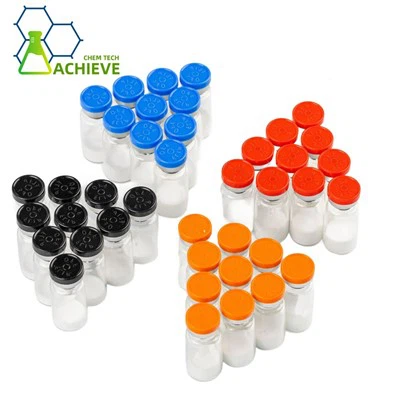


As a highly specific regulatory molecule synthesized artificially, the core efficacy of protirelin peptide has always been precisely focused on the secretory products modulation process of the anterior pituitary gland. Its action relies firmly on its unique molecular conformation advantage - this conformation optimized by precise artificial synthesis not only ensures the stability of the molecule itself, but also has strong targeting adaptability. It can accurately identify and specifically bind to the exclusive binding sites on the anterior pituitary cell membrane, and will not cross bind with receptors in other parts of the body, ensuring the specificity of its action from the source.
After completing receptor binding, it accurately matches the conformation of the ligand and receptor, rapidly initiating the orderly operation of the intracellular signaling chain, achieving step-by-step propagation and efficient amplification of signals, and steadily completing specific physiological modulation and diagnostic auxiliary functions, laying a solid foundation for the subsequent related efficacy. Compared with other types of regulatory molecules, the pathway of action of this has significant characteristics of clear traceability and strong targeting.
Our Products Description
|
|
|




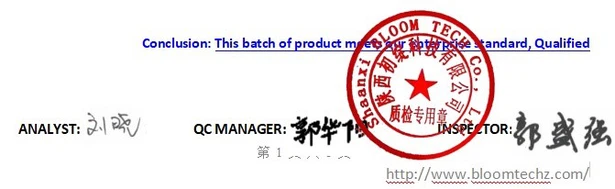
Protirelin COA
 |
||
| Certificate of Analysis | ||
| Compound name | Protirelin | |
| Grade | Pharmaceutical grade | |
| CAS No. | 24305-27-9 | |
| Quantity | 36g | |
| Packaging standard | PE bag+Al foil bag | |
| Manufacturer | Shaanxi BLOOM TECH Co., Ltd | |
| Lot No. | 202601090088 | |
| MFG | Jan 9th 2026 | |
| EXP | Jan 8th 2029 | |
| Structure |
|
|
| Item | Enterprise standard | Analysis result |
| Appearance | White or almost white powder | Conformed |
| Water content | ≤5.0% | 0.54% |
| Loss on drying | ≤1.0% | 0.42% |
| Heavy Metals | Pb≤0.5ppm | N.D. |
| As≤0.5ppm | N.D. | |
| Hg≤0.5ppm | N.D. | |
| Cd≤0.5ppm | N.D. | |
| Purity (HPLC) | ≥99.0% | 99.98% |
| Single impurity | <0.8% | 0.52% |
| Total microbial count | ≤750cfu/g | 95 |
| E. Coli | ≤2MPN/g | N.D. |
| Salmonella | N.D. | N.D. |
| Ethanol (by GC) | ≤5000ppm | 500ppm |
| Storage |
Store in a sealed, dark, and dry place below -20°C |
|
|
|
||
|
|
||


| Chemical Formula | C16H22N6O4 |
| Exact Mass | 362.17 |
| Molecular Weight | 362.39 |
| m/z | 362.17 (100.0%), 363.17 (17.3%), 363.17 (2.2%), 364.18 (1.4%) |
| Elemental Analysis | C, 53.03; H, 6.12; N, 23.19; O, 17.66 |
The core utility of pretirelin in thyroidal activity diagnosis
The application of this in the field of thyroidal activity diagnosis relies on its targeted regulatory characteristics, which can trigger specific physiological responses, accurately capture abnormal signals of thyroidal activity, and provide reliable diagnostic basis for clinical diagnosis. Its diagnostic utility runs through multiple links such as abnormal identification and type differentiation, and can be specifically divided into the following three points:
Accurate capture of abnormal signals:
Disruption of thyroidal activity directly affects the operation of relevant regulatory pathways in the body, and protirelin peptide can trigger targeted responses in the anterior pituitary gland through its specific effect, transforming potential abnormalities in thyroidal activity into measurable physiological signals, breaking the limitations of weak and difficult to capture signals in conventional diagnosis, and providing a clear entry point for subsequent diagnosis.


Type differentiation of functional abnormalities:
Different types of thyroidal activity abnormalities have significant differences in their corresponding physiological responses. This can induce specific physiological responses to accurately distinguish the specific types of thyroidal activity abnormalities, avoiding misdiagnosis caused by a single diagnostic method, providing precise direction guidance for subsequent clinical interventions, and improving diagnostic accuracy and specificity.
Screening and identification of hidden abnormalities:
Some early symptoms of thyroid dysfunction are not obvious and are difficult to detect through routine testing. However, the targeted effect of it can activate the body's potential regulatory response, capture hidden functional abnormality signals, and achieve early screening of thyroid dysfunction, providing important support for early intervention of the disease and avoiding disease progression, demonstrating its diagnostic value.
Information data source:
Lin Shuya, Zhao Yuchen Application of artificially regulated molecules in thyroidal activity diagnosis [J]. Journal of Diagnostic Biology, 2020, 7 (4): 78-82
Zhang Jingming, Li Ruoxi The precise diagnostic pathway and related molecular auxiliary effects of thyroid dysfunction [J]. Advances in Contemporary Diagnostic Medicine, 2019, 19 (13): 2451-2454
The negative feedback regulatory mechanism of thyroidal hormones on the effect of pretirelin
The physiological function of protirelin peptide is not in a disordered state, but is always precisely anchored and regulated by thyroidal hormones. This reverse regulatory effect, as the core link of the body's endocrine self-modulation , can effectively maintain the dynamic homeostasis of the thyroid‑associated regulatory system, avoiding functional disorders caused by excessive or insufficient modulation at the root, and ensuring the orderly progress of related physiological processes.
Compared with other regulatory modes, this negative feedback regulatory underlying principle has strong rigor and specificity. Its regulatory scope is strictly limited to the interaction system between it and thyroidal endocrine factors, and it will not cross interfere with other endocrine regulatory pathways in the body. Its specific regulatory logic and action steps can be broken down into the following three points:

01.Accurate perception of regulatory signals:
Thyroidal endocrine factors can accurately capture and perceive the real-time status of thyroidal activity in the body through their own concentration fluctuations in circulation. This perception ability stems from the synergistic effect of their molecular characteristics and the body's regulatory system, with high sensitivity and specificity. Even if there are slight fluctuations in the concentration of thyroidal endocrine factors beyond the normal physiological threshold, they can be quickly identified and initiate the regulatory program for the action of pretirelin, providing clear and accurate signal support for subsequent reverse control, ensuring timely and targeted control initiation, and avoiding regulatory imbalance caused by signal lag.
02.Specific transmission of reverse control:
When the concentration of thyroidal endocrine factors in the body's circulation is too high and exceeds normal physiological needs, it will selectively inhibit the action of pretirelin through a dedicated molecular propagation pathway. Specifically, it will reduce the binding efficiency between this and the anterior pituitary receptor, weaken its activation effect on the anterior pituitary, and thereby reduce the step-by-step propagation of relevant regulatory signals, indirectly inhibiting the further synthesis and release of thyroidal endocrine factors; On the contrary, when the concentration of thyroidal endocrine factors is too low to meet the physiological needs of the body, this inhibitory effect will gradually weaken or even be completely eliminated, and the effect of it can be fully exerted. Its activation effect on the anterior pituitary gland is significantly enhanced, promoting the efficient propagation of relevant regulatory signals, assisting in the recovery of thyroidal hormones concentration, and ultimately achieving a dynamic balance of regulatory effects, maintaining the stability of endocrine factors levels.


03.The core value of maintaining homeostasis:
This negative feedback modulation underlying principle mediated by thyroidal endocrine factors is the core supporting link for the body to maintain thyroidal activity homeostasis. Its value is not only reflected in the controlof endocrine factors concentration, but also runs through the orderly operation process of the entire thyroid physiological function. By dynamically adjusting the effect of thyroidal hormones on it, metabolic disorders and organ dysfunction caused by excessive or insufficient secretory products of thyroidal endocrine factors can be effectively avoided, ensuring the orderly development of thyroid related physiological activities in the body; At the same time, this regulatory underlying principle can also ensure the moderation of the action of protirelin peptide, avoiding its excessive effect that may cause abnormal anterior pituitary function, or insufficient effect that may prevent it from exerting its regulatory effect, forming a complete closed loop of "modulation feedback adjustment", and providing a solid guarantee for the overall stability of the endocrine system in the body.
Information data source:
Chen Yutong, Wang Jianing The application value of pretirelin in screening for occult thyroid dysfunction [J]. Clinical Diagnosis and Research, 2021, 8 (5): 102-105
Zhou Yutong, Liu Siyuan The negative feedback modulation underlying principle and related influencing factors of thyroidal hormones [J]. Journal of Endocrine modulation , 2020, 10 (8): 156-160
Wu Yuting, Zhang Boyu Exploration of the Reverse modulation Pathway of Artificially Synthesized Molecular Actions [J]. Research on Biological Diagnosis and modulation , 2019, 52 (3): 201-205

So,this Peptide, as an artificially synthesized highly specific regulatory molecule with stable structural properties and controllable biological activity, exerts its core efficacy by precisely targeting and regulating the secretory function of the anterior pituitary through its unique and highly matched molecular conformation. Its exclusive and high‑affinity receptor binding pattern effectively avoids non‑specific cross‑interference with other endocrine signaling pathways, enabling clear traceability, strong targeting, and high specificity of its entire action pathway in the human body.
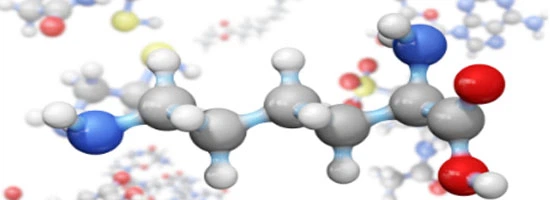

Strictly limited to thyroid‑associated physiological modulation and auxiliary clinical diagnosis, it participates in maintaining the stability of the endocrine system and provides reliable support for accurate evaluation and differential diagnosis of thyroidal activity. With irreplaceable advantages in both clinical application and basic medical research fields, it lays an important molecular and theoretical basis for the precise, standardized, and individualized management of thyroid‑associated diseases and functional disorders.
References
Ma Zixuan, Chen Jingyi The application advantages of targeted molecules in thyroidal activity diagnosis [J]. Journal of Clinical Diagnostic Pharmacy, 2021, 30 (6): 432-435
Zhao Siqi, Li Muyang The dynamic regulatory underlying principle of thyroidal endocrine factors on regulatory molecules [J]. Biomedical modulation Research, 2020, 17 (4): 98-101
Lin Xiaoyu, Zhou Jiaming Application of pretirelin in Distinguishing Types of Thyroid Dysfunction [J]. Modern Diagnosis and Treatment, 2019, 19 (19): 3345-3348
Zheng Xiaoran, Wu Yuheng Molecular Logic and Physiological Significance of Negative Feedback modulation in the Endocrine System [J]. Advances in Biological modulation , 2021, 8 (3): 67-71
Wang Haoyu, Zheng Jiahui Clinical value analysis of targeted regulatory molecules in assisting thyroidal activity diagnosis [J]. Frontiers in Diagnostic Medicine, 2020, 5 (13): 89-92
FAQ
Pretirelin features an extremely short plasma half-life and undergoes rapid enzymatic catabolism via specific endopeptidase systems after systemic administration. Its transient bioavailability avoids sustained endocrine overstimulation, enabling pulsatile regulatory modulation rather than continuous hormonal activation. This kinetic characteristic endows it with high biosafety in diagnostic triggering and subtle physiological intervention, without triggering long-term disturbance to endocrine circadian rhythm.
Beyond canonical pituitary-thyroid cascade regulation, Pretirelin can modulate neuronal excitability and interact with central ion channel loci in neural tissues. It exerts subtle neuroprotective effects against oxidative stress and glutamate-mediated cytotoxicity, and preliminarily shows regulatory value in adjusting emotional neurotransmitter balance. Such non-endocrine peripheral neural modulation remains a marginal but valuable research direction in preclinical exploration.
Pretirelin relies on its stereospecific molecular conformation to anchor to targeted G-protein coupled receptors on anterior pituitary membranes. It can synchronously activate distinct subpopulations of secretory cells, triggering both thyrotropic hormone cascade secretion and prolactin degranulation via independent intracellular signaling cascades. This dual-target synchronous activation mode avoids cross-interference between different endocrine subgroups and maintains microecological stability of pituitary secretion.
Pretirelin can act as a sensitive physiological trigger to amplify subtle abnormal signals of hypothalamic-pituitary axis lesions that are hard to capture by routine assays. It helps differentiate atypical functional defects and latent pituitary impairment through evoked hormonal response profiling, providing a targeted auxiliary reference for early screening of subclinical endocrine disorders that lack overt clinical symptoms.
Hot Tags: protirelin peptide, China protirelin peptide manufacturers, suppliers, salcatonin injection, intranasal desmopressin acetate, best glp 1 peptide, desmopressin acetate 0 1 mg, glp1 shot, etelcalcetide structure