


Somatostatin can comprehensively and selectively inhibit the abnormal excessive secretion of multiple hormones including growth hormone, glucagon and insulin, without causing persistent interference to the basic physiological hormone level under the therapeutic dosage. Different from single-target hormone inhibitors, it can act on multiple pathological links related to hormone secretion disorders at the same time, showing unique clinical application value.
Kpeptide products is widely recognized for its definite clinical effects. It is first-line used for the emergency treatment of severe acute esophageal variceal bleeding, gastrointestinal bleeding and pancreatic fistula, which can significantly reduce the splanchnic blood flow, rapidly lower the pressure of portal vein system, and effectively control acute bleeding without obvious adverse effects on systemic hemodynamics.
Our Products Form


Somatostatin COA
 |
||
| Certificate of Analysis | ||
| Compound name | Somatostatin | |
| Grade | Pharmaceutical grade | |
| CAS No. | 51110-01-1 | |
| Quantity | 25g | |
| Packaging standard | PE bag+Al foil bag | |
| Manufacturer | Shaanxi BLOOM TECH Co., Ltd | |
| Lot No. | 202601090056 | |
| MFG | Jan 9th 2026 | |
| EXP | Jan 8th 2029 | |
| Structure |
|
|
| Item | Enterprise standard | Analysis result |
| Appearance | White or almost white powder | Conformed |
| Water content | ≤5.0% | 0.91% |
| Loss on drying | ≤1.0% | 0.34% |
| Heavy Metals | Pb≤0.5ppm | N.D. |
| As≤0.5ppm | N.D. | |
| Hg≤0.5ppm | N.D. | |
| Cd≤0.5ppm | N.D. | |
| Purity (HPLC) | ≥99.0% | 99.90% |
| Single impurity | <0.8% | 0.43% |
| Total microbial count | ≤750cfu/g | 105 |
| E. Coli | ≤2MPN/g | N.D. |
| Salmonella | N.D. | N.D. |
| Ethanol (by GC) | ≤5000ppm | 613ppm |
| Storage | Store in a sealed, dark, and dry place below -20°C | |
|
|
||
|
|
||
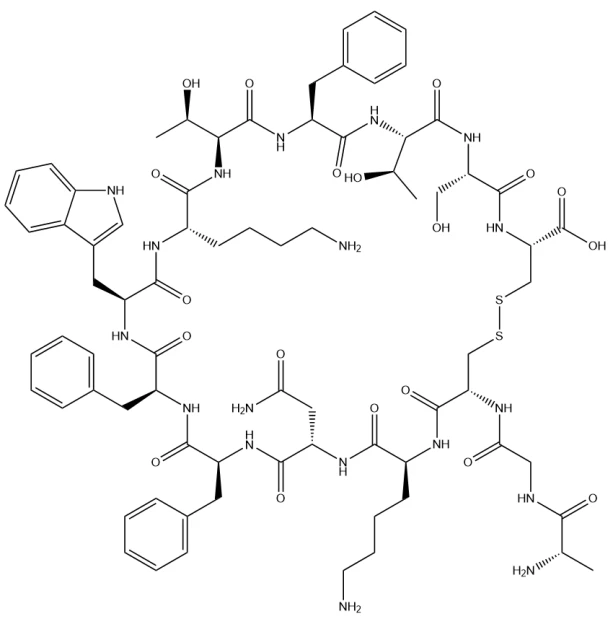


| Chemical Formula | C76H104N18O19S2 | |
| Exact Mass | 1636.72 | |
| Molecular Weight | 1637.90 | |
| m/z | 1636.72(100.0%), 1637.72(82.2%), 1638.72(33.3%), 1638.71(9.0%), 1639.73(8.1%), 1639.72(7.4%), 1637.71(6.6%), 1638.72(5.2%), 1638.72(3.9%), 1639.72(3.2%), 1640.72(3.0%), 1639.72(2.2%), 1640.73(1.8%), 1637.72(1.6%), 1638.72(1.3%), 1640.73(1.3%), 1637.72(1.2%) | |
| Elemental Analysis | C,55.73; H,6.40; N,15.39; O,18.56; S,3.91 | |


Acute upper gastrointestinal bleeding is a common clinical critical illness, referring to acute bleeding caused by lesion rupture in the digestive tract above the ligament of Treitz (esophagus, stomach, duodenum, pancreas, biliary tract, etc.). Its core clinical manifestations include hematemesis, melena, dizziness, fatigue and decreased blood pressure. In severe cases, it can lead to hemorrhagic shock, with a mortality rate as high as 8–15%. In recent years, with population aging and the widespread use of antiplatelet and anticoagulant drugs, its incidence has been increasing annually.
As a synthetic peptide hormone preparation, Somatostatin Injection 3 mg has become a core drug in the treatment of acute upper gastrointestinal bleeding due to its precise mechanism of action, suitable dosage form and specification, and favorable clinical safety.
It plays an irreplaceable role especially in the emergency treatment of severe and refractory bleeding. This article introduces its applications in this therapeutic field in detail from multiple dimensions and combines key clinical practice points to provide a reference for rational clinical medication.
Acute upper gastrointestinal bleeding can be etiologically classified into two major categories: esophageal variceal bleeding (EVB) and non-variceal upper gastrointestinal bleeding (NVUGIB). The former is mainly caused by portal hypertension secondary to liver cirrhosis, accounting for 12%–15% of cases. It is characterized by abrupt onset, massive bleeding, severe condition, high risk of hemorrhagic shock in a short time, and high mortality. The latter, accounting for more than 85%, is dominated by peptic ulcer and acute gastric mucosal lesions, among which peptic ulcer accounts for 50%–60% and acute gastric mucosal lesions 15%–20%. Most non-variceal bleeding episodes are mild and recurrent, though massive bleeding may occur in some patients with large wounds.

The product delivers targeted therapeutic regimens for different bleeding types based on their etiological characteristics, with remarkable clinical efficacy, making it a first‑line drug for both categories.
(I) Application in Variceal Upper Gastrointestinal Bleeding

Variceal upper gastrointestinal bleeding, mainly caused by rupture of esophagogastric varices secondary to liver cirrhosis and portal hypertension, is one of the most life‑threatening forms of acute upper gastrointestinal bleeding. Patients often present with sudden massive hematemesis (usually bright or dark red blood with clots) and melena, which may rapidly progress to acute peripheral circulatory failure and severe anemia. Without timely intervention, mortality can exceed 30%.
The product is a first‑line emergency drug for this type of bleeding. Its core mechanism is to rapidly reduce portal venous pressure and decrease splanchnic blood flow, thereby quickly controlling bleeding and buying time for subsequent treatment.
For patients with massive bleeding and critical condition, 0.25 mg intravenous bolus may be repeated 2–3 times at 3–5‑minute intervals in the early phase to rapidly elevate plasma concentration and improve hemostatic success rate.Once bleeding is controlled (usually within 12–24 hours, defined as no hematemesis, resolution of melena, stable blood pressure and heart rate), the drug should be continued for 48–72 hours to prevent rebleeding. The total treatment course is typically 5 days (120 hours), adjustable according to clinical status.
Clinical studies show that:
Somatostatin Injection 3 mg alone achieves a hemostatic success rate of 70%–80% for esophagogastric variceal bleeding.


When combined with endoscopic sclerotherapy or variceal ligation, the success rate exceeds 90%, significantly reducing mortality and rebleeding rate. It also reduces bleeding during endoscopic procedures, providing a clear surgical field and lowering procedural risks and complications.For patients who cannot immediately undergo endoscopy, pretreatment with this drug stabilizes the condition and creates favorable conditions for subsequent endoscopic intervention.
(II) Application in Non‑Variceal Upper Gastrointestinal Bleeding
Non‑variceal upper gastrointestinal bleeding is the predominant type, with common causes including gastroduodenal ulcer, acute erosive hemorrhagic gastritis, stress ulcer, rupture of gastric polyps, and Mallory‑Weiss syndrome. Most episodes are mild and recurrent; however, massive bleeding may occur due to ulcer perforation or arterial erosion, presenting with hematemesis and melena, and potentially leading to hemorrhagic shock in severe cases. The product achieves hemostasis mainly by inhibiting gastric acid and pepsin secretion, reducing splanchnic blood flow, and promoting coagulation at the bleeding site. It is especially valuable in patients with severe bleeding who respond poorly to conventional hemostatic agents.


1. In gastroduodenal ulcer bleeding
The drug markedly suppresses gastric acid secretion, avoiding acid‑induced irritation of ulcer wounds, and reduces gastrointestinal peristalsis to prevent clot dislodgement, thus facilitating ulcer healing.The regimen is identical to that for variceal bleeding:0.25 mg loading bolus, followed by continuous infusion at 0.25 mg/h, and maintenance for 48–72 hours after bleeding cessation to consolidate hemostasis and lower rebleeding risk.For H. pylori‑positive patients, hemostasis with somatostatin can be followed by eradication therapy combining proton pump inhibitors (PPIs) and antibiotics to cure ulcers at the source and reduce recurrence and rebleeding.
Clinical data demonstrate that combination therapy with it and PPIs shortens hemostasis time to 24–48 hours, with a rebleeding rate below 5%.
2. In acute erosive hemorrhagic gastritis and stress ulcer bleeding
(induced by severe trauma, major surgery, severe infection, cerebrovascular disease, etc.)The product inhibits gastric acid secretion, protects gastric mucosa, reduces bleeding from erosive lesions, and regulates gastrointestinal function to promote mucosal repair.These patients are often in a stressed state with metabolic disturbance and impaired immunity, and bleeding may exacerbate their underlying condition. Rapid hemostasis helps prevent clinical deterioration and supports treatment of the primary disease.
Clinical data show that combination therapy with Somatostatin Injection 3 mg and PPIs yields an overall efficacy rate of 88.5% for non‑variceal upper gastrointestinal bleeding, significantly higher than 70.8% with conventional hemostatic treatment alone.


Somatostatin (SS) is an artificially synthesized cyclic fourteen amino acid peptide with a structure identical to natural somatostatin, but overcoming the drawback of a very short half-life (only 2-3 minutes) of natural preparations. Commonly used clinical preparations include injectable somatostatin (such as Hankang and Suning) and its long-acting analogue Octreotide. This drug occupies an irreplaceable therapeutic position in the fields of acute upper gastrointestinal bleeding and pancreatic diseases due to its dual mechanism of "inhibiting secretion+constricting visceral blood vessels".

1. Application of somatostatin in acute upper gastrointestinal bleeding
(1) Mechanism of action - triple hemostatic defense line
Hemostasis is not a single pathway, but a triple collaborative defense line has been constructed:
Firstly, reducing portal vein pressure (core mechanism). The ability to selectively contract the smooth muscle of visceral blood vessels significantly reduces visceral blood flow, leading to a decrease in portal vein blood flow and pressure, as well as a decrease in hepatic vein pressure gradient (HVPG), thereby reducing blood flow perfusion in esophageal and gastric varices. This is the key to its treatment of variceal bleeding.
Secondly, inhibit the secretion of gastric acid and pepsin. By inhibiting the release of gastrin from gastric antral G cells, inhibiting the release of histamine from intestinal chromaffin cells.
And directly inhibiting the function of parietal cells, the secretion of gastric acid and pepsinogen is effectively reduced, reducing chemical erosion of bleeding wounds and creating a favorable local environment for hemostasis.
Thirdly, promote hemostasis and mucosal repair. It can enhance the tension of the lower esophageal sphincter, promote platelet aggregation and blood clot contraction, increase gastric mucosal blood flow, and accelerate the repair of ulcer surface and mucosal damage.
(2) Clinical Indications and Evidence Based Evidence
(2.1) Esophageal and gastric variceal rupture bleeding (with the strongest evidence)
This is its most core and evidence-based indication. Multiple randomized controlled trials have confirmed that somatostatin can stop bleeding in 71% to 77% of patients on the second day of medication, and in 91% to 97% of patients on the third day, with a significantly better hemostasis rate than cimetidine (66% to 68%) .


The AASLD guidelines (2017), Baveno VI consensus (2015), and UK Gut guidelines (2015) all recommend somatostatin drugs as the standard medication for the acute phase, and suggest starting as early as possible and continuing for 2-5 days.
A clinical study involving 104 patients with acute upper gastrointestinal bleeding showed that the total effective rate of the treatment group was 95.19%, significantly higher than that of the control group (P<0.05). In another study combining thrombin and omeprazole, the total effective rate of the treatment group was as high as 97.72%, and the hemostasis time (18.2 ± 4.5) hours was significantly shorter than that of the control group (32.7 ± 7.3) hours (P<0.05).
(2.2) Non variceal upper gastrointestinal bleeding (limited evidence, can be used as an adjunct)
For peptic ulcer bleeding, acute erosive gastritis, etc., hemostasis can be assisted by inhibiting gastric acid secretion.
However, Carpenter et al.'s systematic review pointed out that somatostatin did not consistently improve hard endpoints such as rebleeding rate and mortality in non variceal bleeding. Therefore, international guidelines emphasize that sufficient proton pump inhibitors (PPIs) should be the core, and only used as transitional measures in special circumstances (such as when endoscopy is temporarily difficult to implement).
3. Application of somatostatin in pancreatic diseases
(1) Prevention and treatment of postoperative complications in pancreatic surgery
It can significantly reduce the internal and external secretion of the pancreas and is one of the most commonly used drugs for preventing and treating postoperative complications such as pancreatic fistula, pancreatic pseudocyst, abdominal infection, etc. It creates favorable conditions for pancreatic duct healing and absorption of pseudocysts by reducing pancreatic juice secretion and minimizing pancreatic fistula leakage.


(2) Adjuvant treatment of pancreatic, biliary, and intestinal fistulas
It can significantly reduce the amount of gastrointestinal fluid leakage and reduce the erosion of digestive fluids on the fistula opening. Combined with parenteral nutrition, it can effectively promote the self-healing of intestinal and pancreatic fistulas.
(3) Prevention of post ERCP pancreatitis (PEP)
For high-risk patients with post ERCP pancreatitis (such as females, history of pancreatitis, Oddi sphincter dysfunction, etc.), if NSAIDs are contraindicated or prophylactic pancreatic stent placement is not possible, somatostatin can be used to prevent PEP, which can reduce its incidence.
(4) Chronic pancreatitis
The "Guidelines for Diagnosis and Treatment of Chronic Pancreatitis (2018, Guangzhou)" states that somatostatin may be effective in relieving pain in chronic pancreatitis and can be used as a preventive treatment option for patients with recurrent episodes.

Dosage form and technological iteration will become a key development direction. At present, the preparation is mainly available as a lyophilized powder for injection. In the future, relying on advances in polypeptide formulation technology, the reconstitution process will be optimized and stability improved to address the shortage of infusion equipment in primary hospitals. In line with the trend of long‑acting formulation development, the combination with sustained‑release technologies will be explored to further extend the dosing interval and enhance convenience and patient compliance.
On the market side, with the progress of consistency evaluation for domestic generic drugs, this dosage form will achieve higher‑quality import substitution. Optimized medical insurance policies and improved DRG/DIP payment models will further enhance drug accessibility, reduce patient burden, and drive steady growth in market demand.
In summary, supported by clinical demand, technological innovation, and favorable policies, the product will achieve dual breakthroughs in both clinical application and market development in the future, with broad development prospects.
References
[1] Yisheng Information Today's Medication | Somatostatin [EB/OL]. 2025
[2] Tencent News One article on understanding somatostatin [EB/OL]. 2026
[3] Bo Xuejing Clinical study on the treatment of acute upper gastrointestinal bleeding with thrombin and somatostatin [J]. Chinese Health Standards Management, 2020, 11 (12): 91-93
[4] Bai Gang, Ma Yuangui Clinical comparative observation of somatostatin in the treatment of acute severe pancreatitis [J]. Chinese Journal of Surgery, 1996
[5] Dr. Bohe The 10 functions of somatostatin [EB/OL]. 2026-03-09
[6] Fuhe Health Gastrointestinal bleeding treated with somatostatin [EB/OL]. October 21, 2025
[7] Dr. Bohe The effect of somatostatin on pancreatitis [EB/OL]. 2026-02-21
[8] Peng Jianhui Observation of the therapeutic effect of somatostatin on 35 cases of upper gastrointestinal bleeding [J]. Hainan Medical Journal, 2011 (5)
[9] Clinical efficacy observation of somatostatin in the treatment of severe acute pancreatitis [J]. Journal of Practical Clinical Medicine, 2024
[12] Observation of the therapeutic effect of somatostatin on acute upper gastrointestinal bleeding [J]. 2011 (2)
[13] WeChat public platform Do you know the uses of somatostatin in the digestive system besides hemostasis? [EB/OL]. September 3, 2024
[14] Min Fukang The effect of somatostatin in the treatment of gastrointestinal bleeding [EB/OL]. 2026-04-12
[20] WeChat public platform Application of somatostatin in gastrointestinal bleeding - alert to insufficient evidence in many scenarios [EB/OL]. December 30, 2025
FAQ
What is somatostatin 3mg injection used for?
+
-
Somatostatin helps treat acromegaly and certain hormone-producing tumors of stomach, liver, and pancreas. It is given as an injection under the skin or into a vein. It may temporarily cause pain at the site of injection. You can relieve this by gently rubbing the site of injection for a few seconds afterwards.
What diseases are linked to somatostatin?
+
-
The clinical syndrome associated with somatostatinoma results from the excessive production of somatostatin. This classic triad includes diabetes mellitus, steatorrhea, and cholelithiasis.
What are the side effects of somatostatin?
+
-
Somatostatin analogs (e.g., octreotide, lanreotide) commonly cause gastrointestinal issues, including diarrhea, nausea, vomiting, abdominal pain, and bloating, which often improve over time. Other frequent side effects include gallbladder sludge or stones, injection site pain, fatigue, headaches, dizziness, and hyperglycemia (high blood sugar).
Hot Tags: somatostatin injection 3 mg, China somatostatin injection 3 mg manufacturers, suppliers, salcatonin injection, intranasal desmopressin acetate, best glp 1 peptide, actide 100mcg, glp1 shot, etelcalcetide structure