




PT-141 powder is its most original and unprocessed chemical form. It typically appears as a white to off-white freeze-dried powder or crystalline powder, encapsulated in sterile small glass bottles. As a synthetic heptapeptide, it is a black cortisone receptor agonist at the biochemical level, specifically targeting MC4R. It regulates the sexual desire pathway through the central nervous system. The essence of the powder form is "raw material", meaning it is not a ready-to-use final product. It must be carefully reconstituted and diluted by the user using a specific solvent (such as bacteriostatic water), and then administered by subcutaneous injection. This form is highly concentrated in the gray market and the field of research chemistry, attracting "DIY" enthusiasts who pursue cost-effectiveness and autonomy in dose control. However, it is also fraught with potential dangers due to the lack of standardization, the risk of aseptic operation, purity concerns, and legal disputes. It is separated from the strict pharmaceutical field and placed in a blurry area of autonomy and risk.
Our Products Form
|
|
|
|
|
|
|
|


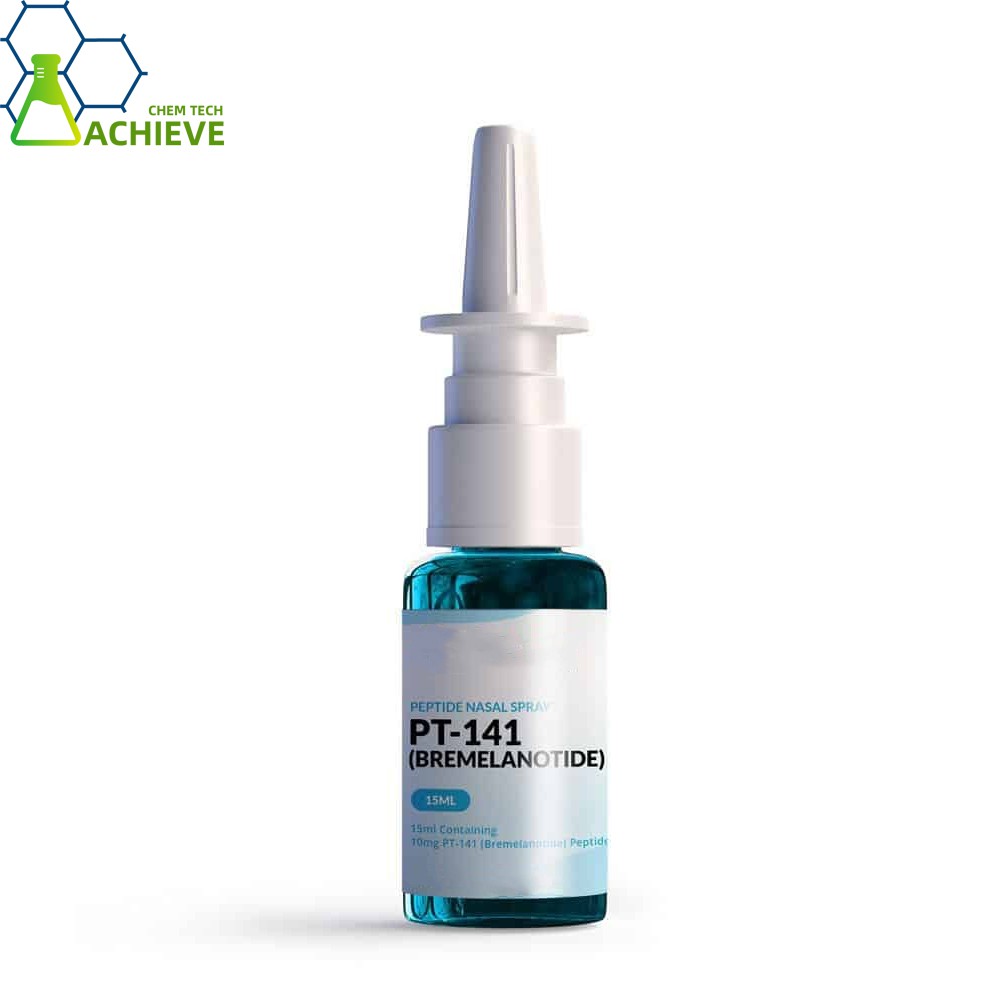

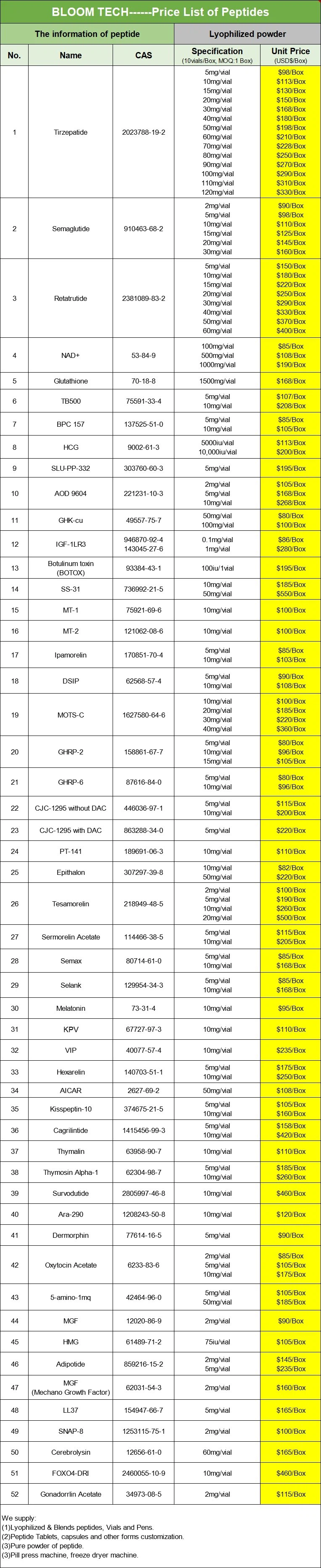

PT-141 COA


PT-141 powder is a peptide-based drug. The analysis of its powder form should focus on core indicators such as purity, impurities, moisture, peptide content, and physical properties. Below, we elaborate on the analysis method from a professional perspective:
|
|
|
|


Purity Analysis (HPLC Method)
High Performance Liquid Chromatography (HPLC) is the core method for determining the purity of PT-141. Using C18 or C8 reversed-phase chromatography columns, with acetonitrile-water (containing 0.1% trifluoroacetic acid) as the mobile phase for gradient elution, the main peak and impurities can be separated. The detection wavelength is typically set at 220nm (the characteristic absorption peak of peptide bonds), and purity is calculated using the area normalization method.
Key Parameters:
Column temperature: 30 - 40℃ (to control peak symmetry)
Flow rate: 1.0 mL/min (to balance separation efficiency and time)
Injection volume: 10 - 20 μL (to avoid column overload)
Result interpretation: A purity of ≥ 98% is the qualified standard. The content of single impurities should be ≤ 2%. If shoulder peaks or double peaks appear, it may indicate the presence of isomers or degradation products.
Impurity Analysis (Multi-method Integration)
Reversed-phase HPLC: used for separating polar impurities (such as un-cyclicated intermediates, peptides lacking sequences).
Ion-exchange chromatography: used to detect charged impurities (such as residual raw materials, salts).
Mass spectrometry (MS): used to confirm the structure of impurities (such as oxidation products, deamidation products).
Typical impurity cases:
Asp5 isomerization: Aspartic acid residues are prone to undergo configuration inversion under acidic conditions, resulting in a decrease in biological activity.
Trp6 oxidation: The indole ring of the tryptophan side chain is easily oxidized to form hydroxyl or diketone derivatives, affecting the stability of the drug.
Nle4 missing peptide: Sequence loss may occur during synthesis due to the loss of protecting groups.
Moisture determination (Karl Fischer method)
PT-141 powder is prone to moisture absorption, and the moisture content must be strictly controlled at ≤ 10%. The Karl Fischer method quantifies moisture through the chemical reaction of iodine oxidizing sulfur dioxide. The operation steps are as follows:
Weigh 50 - 100 mg of the sample into a dry reaction bottle.
Inject the Kjeldahl reagent until the endpoint (potential jump or color change) is reached.
Calculate the moisture content based on the reagent consumption. Notes:
The sample needs to be dried to a constant weight (to avoid interference from surface moisture).
The reaction environment should be protected by inert gas (to prevent atmospheric moisture from seeping in).
Peptide Content Determination (Elemental Analysis/Amino Acid Analysis)
Elemental Analysis: The peptide content is calculated by determining the proportion of C, H, and N elements (Theoretical value: C 58.5%, H 6.7%, N 19.1%).
Amino Acid Analysis: After hydrolyzing the sample, separate and quantify each amino acid using HPLC, and confirm the peptide content by comparing with the theoretical sequence.
Key points of operation:
Hydrolysis conditions: 6M HCl, 110℃, 24h (to ensure complete cleavage of peptide bonds).
Derivatization: Use p-toluenesulfonyl isocyanate (PITC) to improve the sensitivity of amino acid detection.
Physical Property Evaluation
Appearance: Qualified products should be white to off-white powder, without lumps or discoloration.
Solubility:
Soluble in DMSO and methanol (slightly soluble), water solubility requires ultrasonic assistance.
The solution after dissolution should be clear, without particles or flocculent substances.
pH value: Prepare a 1mg/mL solution and measure with a pH meter (Theoretical value: 4.5-6.5).
Optical Rotation: Determine by an optical rotation meter (Theoretical value: [α]D²⁵ -16° to -20°), to confirm the correctness of the stereoconfiguration.
Stability Study (Accelerated Test)
Place PT-141 powder in a 40℃/75%RH environment, and take samples regularly to test key indicators:
Month 0: Baseline data (purity, moisture content, peptide content).
Months 1-3: Observe the trend of impurity growth (such as oxidation products, isomers).
Month 6: Comprehensive assessment of stability (passing criteria: purity decrease ≤ 2%, moisture increase ≤ 1%).
Result application: Determine the expiration date (typically 24-36 months) and storage conditions (recommended -20℃ for freezing storage).
Special Project Analysis
|
|
|


Acetate content: If in the form of acetate, the acetate ion content should be determined by ion chromatography or titration (theoretical value: 5%-12%).
Bacterial endotoxin: Detected by the Limulus amebocyte lysate test method in accordance with the Chinese Pharmacopoeia, with a limit of ≤ 0.5 EU/mg (ensuring the safety of sterile preparations).
Residual solvents: Detected by gas chromatography using organic solvents used in the synthesis (such as DMF, DMSO), and the limit must comply with the ICH guidelines.
Hidden impurities
PT-141 powder, as a peptide-based drug, may contain various impurities during the production process. These impurities may originate from raw materials, synthesis steps, purification processes, or storage conditions. The details are as follows:
Synthetic related impurities

Uncyclicated intermediates
The synthesis of PT-141 involves a cyclization step. If the cyclization is incomplete, linear polypeptide impurities that are not cyclic may be produced. These impurities are structurally similar to the target product, but their biological activity may be significantly reduced, or even cause unknown side effects.
Missing sequence peptides
During solid-phase synthesis, if the amino acid coupling efficiency is insufficient, sequence deletion (such as the loss of a single amino acid) may occur, resulting in short peptide impurities. These impurities may competitively bind to receptors, affecting the efficacy of the drug.


Residual protecting groups
The protecting groups (such as Fmoc, Boc) used in the synthesis may remain in the product if they are not completely removed. Residual protecting groups may affect the stability of the drug or trigger immunogenic reactions.
Degraded impurities
Oxidation products: The tryptophan (Trp) and methionine (Met) residues in the PT-141 molecule are prone to oxidation, generating hydroxyl or di-ketone derivatives. The oxidation products may reduce the drug activity or even cause toxicity.
Deamidation products: The asparagine (Asn) or glutamine (Gln) residues are prone to deamidation under acidic or alkaline conditions, generating aspartic acid (Asp) or glutamic acid (Glu) derivatives. The deamidation products may alter the charge distribution of the drug, affecting its binding ability to the receptor.
Isomerization products: The aspartic acid (Asp) residue is prone to configurational inversion under acidic conditions, generating D-isomer. The isomerization products may have completely different biological activities, even antagonizing the drug's action.
Residual solvents and inorganic impurities

Organic solvent residues
If the solvents such as dimethylformamide (DMF) and dichloromethane (DCM) used in the synthesis are not completely removed, they may remain in the final product. Solvent residues may be toxic and need to be strictly controlled within limits.
Inorganic impurities
Metal catalysts (such as palladium, nickel) or reagents (such as sodium iodide) used in the synthesis may remain in the product. Inorganic impurities may catalyze drug degradation or trigger immune reactions.

Microbial contamination
Bacterial endotoxins: If the production environment control is improper, bacterial endotoxins (such as lipopolysaccharide) may be introduced. Endotoxins can cause severe adverse reactions such as fever and shock, and need to be strictly detected using the limulus amebocyte lysate method.
Microbial residues: Contamination of raw materials or equipment may lead to microbial residues, affecting the stability or safety of the drug.
Other potential impurities
Acetate impurities
If PT-141 exists as an acetate form, unreacted acetic acid or acetate impurities may remain. The acetate content should be controlled by ion chromatography or titration.
Polymer impurities
Polypeptides may form dimers or polymers during synthesis or storage, affecting the solubility and bioavailability of the drug.
Impurity control strategies
Optimize synthesis process
Adjust reaction conditions (such as pH, temperature, time) to improve coupling efficiency and reduce the generation of missing sequence peptides.
Strengthen purification steps
Use high-performance liquid chromatography (HPLC) or ion exchange chromatography to further separate impurities, ensuring purity ≥ 98%.
Strict storage conditions
PT-141 powder should be frozen at -20°C and protected from light and moisture to reduce the formation of degradation impurities.
Comprehensive quality testing
Conduct qualitative and quantitative analysis of impurities using methods such as HPLC, mass spectrometry (MS), and nuclear magnetic resonance (NMR) to ensure compliance with pharmacopoeia standards.
FAQ
1. Should men not use PT-141/Bremelanotide?
Bremelanotide injection should not be used for the treatment of HSDD in women who have gone through menopause, in men, or to improve sexual performance.
2. Where is the best place to inject PT 141?
It is given as a shot under your skin, usually in the stomach or thighs. You or your caregiver may be trained to prepare and inject this medicine at home.
3. Is PT-141 safe for men?
PT-141, also known as Bremelanotide, is a synthetic peptide utilized to treat sexual dysfunction in both men and women. For men, PT-141 provides a unique solution for those facing sexual performance challenges by targeting the brain's centers for sexual response.
Hot Tags: pt-141 powder, China pt-141 powder manufacturers, suppliers, salcatonin injection, intranasal desmopressin acetate, best glp 1 peptide, MT2 Injection, glp1 shot, etelcalcetide structure


