


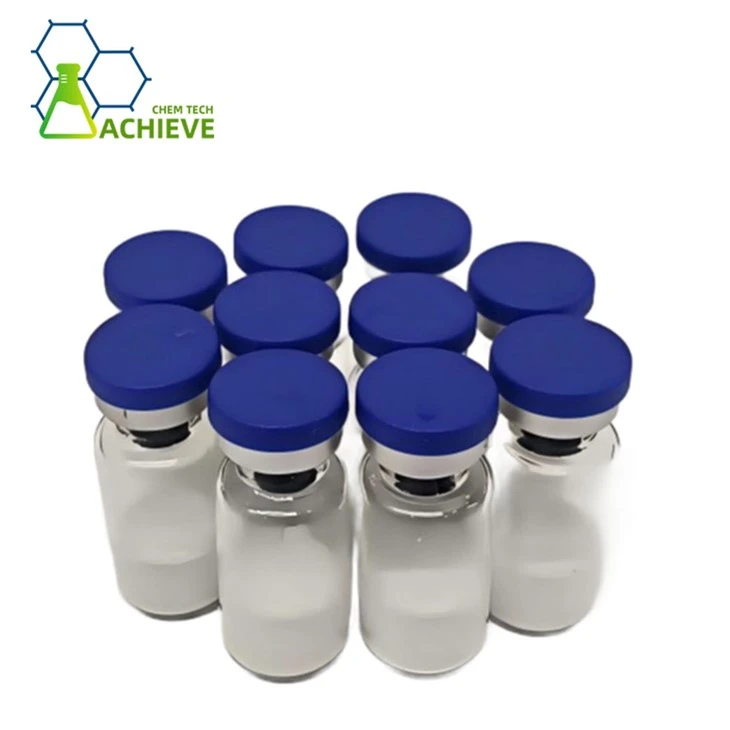


Fertirelin acetate injection is a synthetic gonadotropin-releasing hormone (GnRH) analog primarily used in veterinary medicine to regulate reproductive function in animals. This drug simulates the action of natural GnRH, stimulating the release of luteinizing hormone (LH) and follicle stimulating hormone (FSH) from the pituitary gland, thereby regulating ovulation and reproductive cycles in animals, and has wide applications in veterinary clinical practice.
Our Products Form



Fertirelin Acetate COA
 |
||
| Certificate of Analysis | ||
| Compound name | Fertirelin acetate | |
| Grade | Pharmaceutical grade | |
| CAS No. | 66002-66-2 | |
| Quantity | 50g | |
| Packaging standard | PE bag+Al foil bag | |
| Manufacturer | Shaanxi BLOOM TECH Co., Ltd | |
| Lot No. | 202512090051 | |
| MFG | Dec 9th 2025 | |
| EXP | Dec 8th 2028 | |
| Structure |
|
|
| Item | Enterprise standard | Analysis result |
| Appearance | White or almost white powder | Conformed |
| Water content | ≤5.0% | 0.52% |
| Loss on drying | ≤1.0% | 0.41% |
| Heavy Metals | Pb≤0.5ppm | N.D. |
| As≤0.5ppm | N.D. | |
| Hg≤0.5ppm | N.D. | |
| Cd≤0.5ppm | N.D. | |
| Purity (HPLC) | ≥99.0% | 99.80% |
| Single impurity | <0.8% | 0.37% |
| Total microbial count | ≤750cfu/g | 85 |
| E. Coli | ≤2MPN/g | N.D. |
| Salmonella | N.D. | N.D. |
| Ethanol (by GC) | ≤5000ppm | 400ppm |
| Storage | Store in a sealed, dark, and dry place below -20°C | |
|
|
||
|
|
||



Chemical Information
| Chemical Formula: | C57H80N16O14 |
| Exact Mass: | 1213 |
| Molecular Weight: | 1213 |
| m/z: | 1213 (100.0%), 1214(61.6%), 1215 (18.7%), 1154 (5.9%), 1155 (3.5%), 1156 (2.5%), 1155 (2.5%), 1156 (1.5%), 1156 (1.0%) |
| Elemental Analysis: | C, 56.42; H, 6.65; N, 18.473; O, 18.46 |

Fertirelin acetate injection, as a synthetic gonadotropin-releasing hormone (GnRH) analogue, has demonstrated extensive application value in the field of veterinary medicine due to its unique molecular structure and biological properties. Its molecular formula is C57H80N16O14, and its CAS number is 66002-66-2. By simulating the physiological effects of natural GnRH, it stimulates the release of luteinizing hormone (LH) and follicle stimulating hormone (FSH) from the pituitary gland, thereby regulating the reproductive function of animals.
Treating reproductive system diseases
Follicular cysts are a common cause of reproductive disorders in cows, characterized by the formation of persistent cystic follicles on the ovaries, leading to disrupted estrus cycles and decreased fertility rates. Traditional treatment methods include hormone injection or surgical intervention, but they have limitations such as high cost and complex operation. Tetracycline acetate directly acts on the anterior pituitary gland by simulating the pulsatile release mode of GnRH, activating the secretion of LH and FSH, promoting the rupture and ovulation of cystic follicles. Research has shown that after a single intramuscular injection of cetirizine acetate (at a dose of 100-200 μ g), the LH level in cows reaches its peak within 2-4 hours, the disappearance rate of follicular cysts can reach over 80%, and the pregnancy rate is significantly improved.


Its mechanism of action may involve the following aspects:
Direct stimulation of LH release: binding to pituitary GnRH receptors, triggering intracellular signal transduction, promoting LH gene expression and secretion.
Regulating follicular development: Through the synergistic effect of FSH, promoting the selection and maturation of dominant follicles and inhibiting the overgrowth of non dominant follicles.
Restore ovarian function: Reverse the continuous secretion of estrogen by cystic follicles and rebuild a normal estrous cycle.
Ovarian quiescence is another important reason for the decline in reproductive performance of sows, manifested as the absence of follicle development and stagnant hormone secretion in the ovaries. By exogenous supplementation of GnRH analogs, the dormant state of the ovaries can be activated, promoting the recruitment and development of follicles. Injecting atezolin acetate (dose 50-100 μ g) within 24 hours after weaning in sows can significantly shorten the estrus interval (average 3-5 days), and increase ovulation and embryo implantation rates.


Its therapeutic effect may be related to the following factors:
Breaking negative feedback inhibition: In the quiescent state of the ovaries, the hypothalamic pituitary ovarian axis (HPO axis) is in an inhibited state, and acetate fertireline breaks the negative feedback cycle by forcibly activating GnRH receptors.
Promoting follicular wave development: The ovaries of sows have characteristics of follicular wave development, and atezolin acetate can synchronize the development of multiple follicles and increase ovulation rate.
Improving endometrial receptivity: By regulating the secretion balance of estrogen and progesterone, optimizing the endometrial environment, and increasing embryo survival rate.
Regulating the reproductive cycle
Synchronized estrus is a key technology for improving reproductive efficiency in intensive farming. Fertirelin acetate injection can synchronize the estrous cycle of female livestock by exogenously controlling the release of LH and FSH. The specific operations include:
Single injection method: Inject atezolin acetate (at a dose of 100-200 μ g) at any stage of the estrus cycle in cows or sows to induce the appearance of LH peaks, promote follicle rupture and ovulation, and then maintain luteal function through exogenous progesterone (such as CIDR) to achieve estrus synchronization.
Two injection method: After the first injection of Furirelin Acetate, inject again 7-10 days apart to simulate the double LH peak in the natural estrus cycle, improve ovulation synchronization rate and pregnancy rate.

Regulating ovulation time

In artificial insemination (AI) or embryo transfer (ET), precise control of ovulation time can significantly improve the success rate of reproduction. By inducing LH peaks, ovulation time can be accurately predicted (usually 24-36 hours after injection), thereby optimizing the timing of mating or embryo transfer. For example, in the superovulation program for cows, the combination of acetate and FSH can synchronize the development and ovulation of multiple follicles, increasing the number of available embryos.
Poor uterine involution after childbirth is a common cause of reproductive disorders in female livestock. By regulating ovarian hormone secretion, it can promote the repair of the endometrium and the contraction of the uterine muscle layer. Research has shown that postpartum injection of cetirizine acetate (dose 50-100 μ g) can shorten the time of uterine involution (average 2-3 days) and reduce the incidence of endometritis. Its mechanism of action may involve:
Promote estrogen secretion: Estrogen can stimulate the proliferation and angiogenesis of endometrial epithelial cells, accelerating uterine repair.
Enhancing uterine contractility: Through the synergistic effect of progesterone, the contraction frequency and intensity of the uterine muscle layer are increased, promoting the discharge of lochia.

Assisted reproductive technology
Embryo transfer

Embryo transfer is an important means to improve the reproductive efficiency of excellent female livestock. By regulating the ovulation time of the donor female animal and the synchronous estrus of the recipient female animal, the success rate of embryo transfer can be significantly improved. For example, after superovulation in the donor cow, injection of Furirelin acetate can precisely control the ovulation time and ensure that the embryo is in the optimal developmental stage; In the synchronous estrus treatment of recipient cows, ethinylestradiol acetate can induce LH peak, synchronize endometrial and embryonic development, and improve implantation rate.
Superovulation is the core process of embryo transfer technology, which aims to release multiple mature eggs at once through exogenous hormone treatment in female animals. Furtilin acetate, as an inducer of LH peak, can be used in combination with FSH to enhance the effect of superovulation. The specific plan includes:
FSH depletion method: On the 8th to 12th day of the cow's estrus cycle, daily injections of FSH (total amount of 40-60mg) are administered in a decreasing manner. At the same time, during the last two FSH injections, combined with the use of 100 μ g of cetirizine acetate, to induce LH peak and ovulation.
CIDR-FSH method: CIDR (containing progesterone) is placed in the vagina of cows to suppress estrus, while FSH (total dose of 30-40mg) is injected. When CIDR is removed, Furirelin acetate (dose of 100 μ g) is injected to achieve superovulation and estrus synchronization.

Gender control

Gender control is an important requirement in modern animal husbandry. By regulating the fertilization ability of X and Y sperm, gender control can be indirectly achieved. Research has shown that injecting atezolin acetate before ovulation can alter the physicochemical properties of cervical mucus, affecting the penetration ability of X and Y sperm, thereby increasing the birth rate of offspring of specific genders. However, further verification of its stability and reliability is still needed for this method.
Immune regulatory effect
By regulating the secretion of growth hormone (GH), the non-specific immune function of the body can be enhanced. Research has shown that in immunosuppressed mouse models, ethinylcholine acetate can significantly increase the weight of thymus and spleen, enhance the phagocytic function of mononuclear phagocytes, and enhance the delayed type hypersensitivity response induced by dinitrochlorobenzene (DNCB). Its mechanism of action may involve:
Promote GH release: GH can stimulate the growth and differentiation of lymphoid tissue, enhance the activity of immune cells.
Regulating cytokine secretion: can increase the levels of cytokines such as IL-2, indirectly reflecting the enhancement of cellular immune function.

Improve reproductive related immune responses

The immune response during the reproductive process of female livestock, such as embryo implantation and maternal fetal interface immune tolerance, has a significant impact on their reproductive success rate. Fertirelin acetate injection can optimize the immune environment at the maternal fetal interface and improve embryo survival by regulating the secretion of GH and sex hormones. For example, injection of acetic acid fipronil in early pregnancy of sows can reduce embryonic mortality, which may be related to the establishment of immune tolerance.
Frequently Asked Questions
1. What is Fertirelin acetate and what is its main function?
+
-
Fertirelin acetate is a synthetic analog of gonadotropin - releasing hormone (GnRH). Its main function is to regulate the hypothalamic - pituitary - gonadal axis. By mimicking the action of natural GnRH, it can bind to GnRH receptors on the pituitary gland. This binding leads to the release of luteinizing hormone (LH) and follicle - stimulating hormone (FSH). In the context of animal reproduction, it is widely used to control and synchronize the reproductive cycles of animals, such as in cattle. For example, it can induce ovulation in cows, helping to synchronize their estrous cycles, which is crucial for efficient artificial insemination and improving the overall reproductive performance of the herd.
2. What are the potential side - effects of Fertirelin acetate in animals?
+
-
Although Fertirelin acetate is generally well - tolerated in animals when used correctly, there can be some potential side - effects. One common side - effect is a transient increase in body temperature in some animals after administration. This may be due to the physiological response triggered by the release of hormones. Additionally, in rare cases, excessive or improper use of Fertirelin acetate can lead to ovarian hyperstimulation. This condition can cause the ovaries to become enlarged and may result in discomfort for the animal, as well as potential complications in the reproductive process. It is also possible for animals to show signs of restlessness or changes in behavior shortly after injection, which are usually temporary and subside as the drug's effects wear off.
3. How should Fertirelin acetate be stored?
+
-
Fertirelin acetate should be stored in a cool, dry place, away from direct sunlight and heat sources. The ideal storage temperature is usually between 2 - 8°C (36 - 46°F), similar to the storage conditions for many other pharmaceutical products. It is important to keep the product in its original packaging until it is ready for use to protect it from contamination and moisture. Once the vial is opened, it should be used within a specified period as indicated on the product label, as the stability of the drug may be affected after opening. Additionally, Fertirelin acetate should be stored out of the reach of children and unauthorized personnel to prevent accidental ingestion or misuse.
Hot Tags: fertirelin acetate injection, China fertirelin acetate injection manufacturers, suppliers, salcatonin injection, intranasal desmopressin acetate, best glp 1 peptide, desmomelt tablets, glp1 shot, etelcalcetide structure


