




Teriparatide Injection 20mg is a recombinant human parathyroid hormone analog for the treatment of osteoporosis in patients at high risk of fracture. It replicates the biologically active region of human parathyroid hormone. Distinct from traditional anti-resorptive agents, it features active bone formation as its core mechanism, achieving dual improvement in bone quality.
Our Products Form


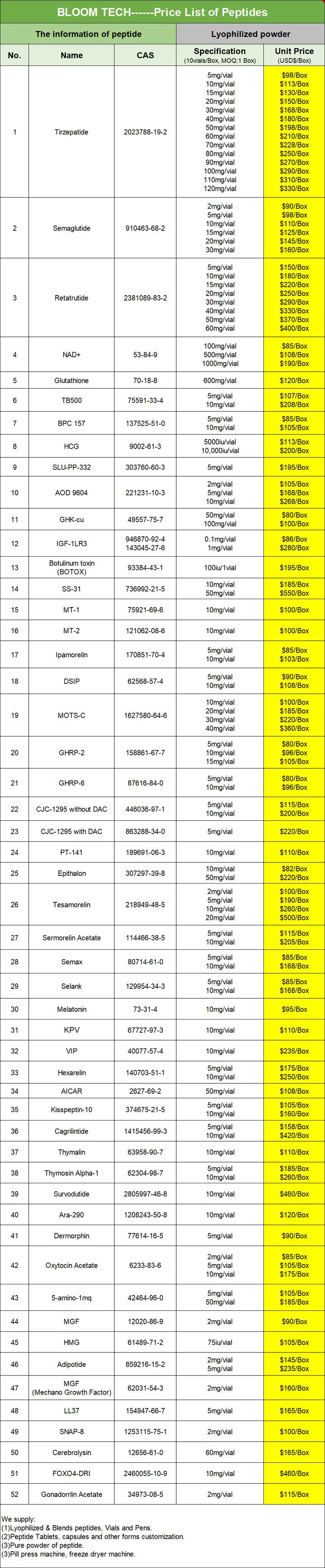


Teriparatide COA
 |
||
| Certificate of Analysis | ||
| Compound name | Teriparatide | |
| Grade | Pharmaceutical grade | |
| CAS No. | 12583-68-5 | |
| Quantity | 44g | |
| Packaging standard | PE bag+Al foil bag | |
| Manufacturer | Shaanxi BLOOM TECH Co., Ltd | |
| Lot No. | 202601090056 | |
| MFG | Jan 9th 2026 | |
| EXP | Jan 8th 2029 | |
| Structure | N/A | |
| Item | Enterprise standard | Analysis result |
| Appearance | White or almost white powder | Conformed |
| Water content | ≤5.0% | 1.32% |
| Loss on drying | ≤1.0% | 0.21% |
| Heavy Metals | Pb≤0.5ppm | N.D. |
| As≤0.5ppm | N.D. | |
| Hg≤0.5ppm | N.D. | |
| Cd≤0.5ppm | N.D. | |
| Purity (HPLC) | ≥99.0% | 99.80% |
| Single impurity | <0.8% | 0.17% |
| Total microbial count | ≤750cfu/g | 500 |
| E. Coli | ≤2MPN/g | N.D. |
| Salmonella | N.D. | N.D. |
| Ethanol (by GC) | ≤5000ppm | 433ppm |
| Storage | Store in a sealed, dark, and dry place below -20°C | |
|
|
||


Osteoporosis is a systemic skeletal disease characterized by significant bone loss and microarchitectural deterioration. Its major consequence is increased bone fragility, which predisposes patients to fragility fractures in the vertebrae, hip, and other sites, severely impairing quality of life and raising disability and mortality rates in the elderly. Conventional osteoporosis therapies are predominantly anti‑resorptive; while they slow bone loss, they do not fundamentally regenerate or repair bone tissue. As the only anabolic osteoporosis agent currently approved for clinical use in China, Teriparatide Injection 20mg occupies an important role in the management of osteoporosis, especially in patients at high fracture risk, providing novel clinical strategies and options.
Core Basic Information of the Drug
The active ingredient of the product is teriparatide, a recombinant human parathyroid hormone analog. Produced by recombinant DNA technology, it corresponds to the active fragment of human parathyroid hormone (PTH 1–34), fully retaining the biological activity of native PTH while optimizing safety and clinical applicability. It is a sterile, colorless, clear injection presented in a single‑patient prefilled pen. Each pen delivers a 28‑day standard dosage without manual compounding, offering convenient administration, precise dosing, and reduced risk of dosing errors during self‑administration.
Pharmacologically, it differs fundamentally from traditional anti‑osteoporosis medications (e.g., bisphosphonates, calcitonins). Conventional agents act as passive protective therapies that primarily inhibit bone resorption by reducing osteoclast activity to slow bone loss. In contrast, it acts as an active bone‑forming therapy: intermittent low‑dose administration preferentially stimulates osteoblast proliferation and activity, promotes new bone formation in both cancellous and cortical compartments, and moderately modulates osteoclast function. This establishes a positive balance where bone formation exceeds resorption, fundamentally increasing bone mineral density, improving bone microarchitecture, and representing its key clinical advantage over other agents.

Application in the Treatment of Osteoporosis
The product is mainly indicated for patients with osteoporosis at high risk of fracture. Based on authoritative domestic and international guidelines as well as clinical practice, its core application scenarios include the following categories, all supported by clear evidence‑based medicine.

(1) Treatment of Osteoporosis in Postmenopausal Women
Postmenopausal women experience a sharp decline in estrogen levels, leading to suppressed osteoblast activity, enhanced osteoclast activity, and rapid bone loss. They constitute a high‑risk population for osteoporosis, with a significantly higher fracture risk than men. The product is one of the first‑line treatments for such patients, especially suitable for those at high fracture risk (e.g., history of vertebral or non‑vertebral fractures, markedly reduced bone mineral density), or those intolerant or unresponsive to other anti‑osteoporosis medications.
Clinical studies have confirmed that postmenopausal women receiving daily subcutaneous injections of 20 μg the product for 12–24 months show significant increases in lumbar spine and hip bone mineral density (BMD), with lumbar spine BMD increasing by more than 9%. Meanwhile, it effectively reduces the risk of vertebral fractures by 65% and non‑vertebral fragility fractures by 53%, relieves low back pain caused by osteoporosis, and improves patients' mobility and quality of life.
Notably, although the drug significantly reduces the risk of vertebral and non‑vertebral fractures, its effect on reducing hip fracture risk has not been fully confirmed; comprehensive evaluation based on individual patient conditions is required in clinical practice.

Information source: NCBI Bookshelf (a resource of the U.S. National Library of Medicine), which specifies efficacy data in postmenopausal women; China Pharmaceutical Information Query Platform, which supplements its indications and limitations.

(2) Treatment of Primary Osteoporosis in Men
Primary osteoporosis in men mostly occurs in the elderly. With aging, decreased testosterone levels, impaired nutrient absorption, reduced physical activity, and other factors jointly cause bone loss. Although fracture risk is lower than in postmenopausal women, the prognosis is poor once fractures occur. Teriparatide Injection 20mg can be used for the treatment of primary osteoporosis in men, especially those with markedly reduced BMD and high fracture risk.
A domestic phase 3, open‑label, multicenter, active‑controlled clinical trial showed that in men with osteoporosis, daily injections of 20 μg the product for 24 weeks resulted in significantly greater BMD improvement than calcitonin therapy, effectively improved bone microarchitecture, and reduced the risk of refracture. In addition, the drug was well tolerated in male patients, with no significant difference in adverse reaction rates compared with female patients; no gender‑based dose adjustment is needed.
Information source: Chinese Expert Consensus on Teriparatide for Osteoporotic Fractures (2024 Edition), confirming its use in male primary osteoporosis; China Pharmaceutical Information Query Platform, supplementing relevant clinical trial data.
(3) Treatment of Glucocorticoid‑Induced Osteoporosis
Long‑term use of glucocorticoids (e.g., prednisone, dexamethasone) is a major cause of secondary osteoporosis. Glucocorticoids directly inhibit osteoblast activity and promote osteoclast proliferation, leading to rapid bone loss and increased fracture risk, particularly in patients receiving long‑term immunosuppressive therapy or those with chronic inflammatory diseases (e.g., rheumatoid arthritis). The product is one of the preferred treatments for such secondary osteoporosis, effectively counteracting skeletal damage caused by glucocorticoids.
In patients with osteoporosis due to long‑term glucocorticoid use, treatment with it effectively activates osteoblasts, promotes bone formation, reverses partial bone loss, and reduces fracture risk, with superior efficacy to traditional anti‑resorptive agents. In clinical practice, the drug can be prioritized for patients on long‑term glucocorticoids with significantly reduced BMD, combined with calcium and vitamin D supplementation to further enhance therapeutic effects.

Information source: Chinese Expert Consensus on Teriparatide for Osteoporotic Fractures (2024 Edition), jointly formulated by authoritative institutions including the China Association for Rehabilitation Technology Transformation and Development and Chinese Medical Association, clarifying its value in glucocorticoid‑induced osteoporosis.
Core Advantages

Compared with traditional anti‑osteoporosis drugs, the core advantage of it lies in its anabolic ("active bone‑forming") mechanism, which fundamentally improves bone quality rather than merely slowing bone loss. Traditional anti‑resorptive agents only produce modest BMD gains (usually ≤3%), whereas this drug increases lumbar spine BMD by more than 9% and provides superior improvement in bone microarchitecture, effectively enhancing bone toughness and strength and reducing fragility fracture risk.
In addition, the drug has a broad indication spectrum: postmenopausal women, men with primary osteoporosis, and patients with glucocorticoid‑induced secondary osteoporosis, especially those intolerant or unresponsive to other therapies, expanding clinical options. Furthermore, its convenient administration (prefilled injection pen) supports self‑administration without professional assistance, improving patient compliance. Serum calcium shows only a transient elevation after dosing; safety is favorable, with mostly mild and transient adverse reactions and high patient tolerability.
Information source: NCBI Bookshelf and Chinese Expert Consensus on Teriparatide for Osteoporotic Fractures (2024 Edition), comprehensively summarizing its clinical advantages.
Contraindicated Populations
Teriparatide Injection 20mg is contraindicated in:
Patients with hypersensitivity to the product or any excipient of the product;
Pregnant and lactating women;
Patients with hypercalcemia;
Patients with severe renal insufficiency;
Patients with metabolic bone diseases other than primary osteoporosis and glucocorticoid‑induced osteoporosis (e.g., hyperparathyroidism, Paget's disease);
Patients with unexplained elevated alkaline phosphatase;
Patients with bone malignancies or skeletal metastases.
Information source: China Pharmaceutical Information Query Platform, FDA Access Data, specifying contraindicated populations.

Key Physicochemical Properties
Teriparatide appears as a white to off-white powder at room temperature. It is hygroscopic, freely soluble in water (solubility approximately 0.40 mg/mL), slightly soluble in dimethyl sulfoxide, sparingly soluble in ethanol, and practically insoluble in non-polar solvents. Its melting point is above 205 ℃ with decomposition during melting. The aqueous solution is weakly acidic, with an appropriate pH range of 4.0–6.0, under which favorable solubility and biological activity can be maintained.
As a polypeptide compound, its molecule contains multiple amino groups, carboxyl groups and amide bonds, exhibiting typical polypeptide chemical characteristics. It can form stable salts with acetic acid and other acids, thereby improving storage stability.
Information source: InvivoChem Chemical Reagent Platform, ChemicalBook, which provide accurate data on its physicochemical properties.
Stability and Storage-Related Chemical Properties
It is chemically unstable, sensitive to temperature, humidity and light, and prone to hydrolysis and oxidation. Unopened product should be stored frozen at -20 ℃, protected from light, and avoid repeated freezing and thawing. After preparation as an injection, it must be stored refrigerated at 2–8 ℃; freezing is strictly prohibited. The injection must be used within 28 days after opening; otherwise, hydrolysis will lead to decreased efficacy and increased impurities.
Its aqueous solution is susceptible to degradation at room temperature, with amino acid fragments as the main degradation products. Strict control of storage conditions is required to minimize degradation and ensure chemical purity and biological activity.
Information source: Drug standards issued by the National Medical Products Administration (NMPA); Trung Tâm Thuốc Pharmacopoeia Special Topics, which specify its stability and storage requirements.
FAQ
Why is the product only 2 years?
+
-
Currently, treatment with it is limited to 2 years because of evidence from a preclinical study that the risk of osteosarcoma might be increased during long-term exposure.
What is the mechanism of action of the product?
+
-
It has the same actions as endogenous PTH on calcium and phosphate homeostasis (ie, it increases serum calcium and lowers serum phosphate). These effects are generated through the well-known effects of PTH on kidneys and bone.
Who should not take the product?
+
-
You should know that the product should only be used by women once they have passed menopause and, therefore, cannot become pregnant or breast-feed. The product should not be used during pregnancy or while breast-feeding.
Hot Tags: teriparatide injection 20mg, China teriparatide injection 20mg manufacturers, suppliers, salcatonin injection, intranasal desmopressin acetate, best glp 1 peptide, calcitonin 100 iu injection, glp1 shot, etelcalcetide structure


