




5-Amino-1MQ Peptide Injection,The full name is 5-Amino-1-methylquinoline, which is a small molecule compound that is not naturally produced by the human body, but developed through artificial synthesis in research environments. This small molecule structure endows it with unique chemical properties and biological activity, enabling it to function at the cellular level and affect human metabolism and physiological processes. Its core mechanism of action lies in its ability to inhibit the activity of nicotinamide N-methyltransferase (NNMT). NNMT is an enzyme that plays a crucial role in human metabolism and energy regulation, particularly active in adipose tissue. It participates in multiple physiological processes such as energy metabolism, fat production, and epigenetic regulation. When 5-Amino-1MQ enters the human body, it binds to NNMT, preventing it from functioning properly and triggering a series of downstream physiological changes.
We not only provide pure powder and capsules, but also other dosage forms. If necessary, please contact our sales team.
Our products from


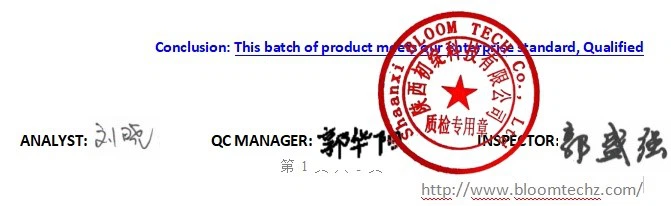
5-Amino-1MQ COA
 |
||
| Certificate of Analysis | ||
| Compound name | 5-Amino-1-methylquinolinium chloride | |
| Grade | Pharmaceutical grade | |
| CAS No. | 42464-96-0 | |
| Quantity | 15g | |
| Packaging standard | PE bag+Al foil bag | |
| Manufacturer | Shaanxi BLOOM TECH Co., Ltd | |
| Lot No. | 202501090030 | |
| MFG | Jan 9th 2025 | |
| EXP | Jan 8th 2028 | |
| Structure |  |
|
| Item | Enterprise standard | Analysis result |
| Appearance | White or almost white powder | Conformed |
| Water content | ≤5.0% | 0.35% |
| Loss on drying | ≤1.0% | 0.27% |
| Heavy Metals | Pb≤0.5ppm | N.D. |
| As≤0.5ppm | N.D. | |
| Hg≤0.5ppm | N.D. | |
| Cd≤0.5ppm | N.D. | |
| Purity (HPLC) | ≥99.0% | 99.90% |
| Single impurity | <0.8% | 0.48% |
| Total microbial count | ≤750cfu/g | 98 |
| E. Coli | ≤2MPN/g | N.D. |
| Salmonella | N.D. | N.D. |
| Ethanol (by GC) | ≤5000ppm | 400ppm |
| Storage | Store in a sealed, dark, and dry place below -20°C | |
|
|
||
|
|
||

| Chemical Formula: | C10H11ClN2 |
| Exact Mass: | 194.06 |
| Molecular Weight: | 194.66 |
| m/z: | 194.0 (100.0%),196.06(32.0%),195.06(10.8%),197.06(3.5%) |
| Elemental Analysis: | C, 61.70; H, 5.70; Cl, 18.21; N, 14.39 |

5-Amino-1MQ Peptide Injection (5-Amino-1-methylquinoline) is an artificially synthesized small molecule compound that has attracted attention in the fields of health and medicine in recent years due to its unique metabolic regulatory effects. Its core applications revolve around weight management, metabolic optimization, and anti-aging support. By inhibiting key enzymes (NNMT) to activate cellular energy metabolism pathways, it provides new ideas for improving obesity, metabolic syndrome, and aging related issues
Delaying cellular aging
Molecular mechanisms and intervention targets of cellular aging

The core characteristics of cellular aging
Cellular senescence refers to the irreversible cell cycle arrest caused by factors such as telomere shortening, DNA damage accumulation, oxidative stress, etc., after multiple divisions of cells. Its core features include:
Metabolic imbalance: The NAD+/NADH ratio in aging cells decreases, leading to a decrease in energy metabolism efficiency;
Mitochondrial dysfunction: loss of mitochondrial membrane potential, increased ROS generation, leading to oxidative damage;
Epigenetic changes: disrupted DNA methylation patterns, abnormal histone modifications, leading to gene expression disorders;
Aging related secretory phenotype (SASP): secretes pro-inflammatory factors such as IL-6 and TNF - α, exacerbating tissue inflammation and fibrosis.
Intervention strategies for delaying cellular aging
The intervention strategies for cellular aging can be divided into two categories:
Clearing senescent cells: selectively inducing apoptosis of senescent cells through Senolytics drugs (such as dasatinib+quercetin) therapy (such as chimeric peptide E16-uPA24);
Reverse aging phenotype: restore cellular metabolic balance and function by activating Sirtuins family proteins, supplementing NAD+precursors (such as NMN), or inhibiting NNMT activity.
5-Amino-1MQ belongs to the latter, which delays the process of cellular aging by inhibiting NNMT activity and reshaping the cellular metabolic network.

Preclinical evidence of 5-Amino-1MQ delaying cellular aging

Metabolic Syndrome and Obesity Model
In a diet induced obese mouse model, injection of 5-Amino-1MQ (50 mg/kg, once daily for 8 weeks) significantly improved metabolic indicators:
Weight management: Weight loss of 18%, epididymal fat pad weight loss of 35%;
Insulin sensitivity: Fasting blood glucose decreased by 22%, HOMA-IR index improved by 40%;
Adipose tissue remodeling: NNMT activity in white adipose tissue decreased by 60%, NAD+levels increased by 2.3 times, and mitochondrial DNA copy number increased by 1.5 times.
Mechanism studies have shown that 5-Amino-1MQ activates SIRT1 by increasing NAD+levels, promotes PPAR - γ deacetylation, inhibits the expression of adipogenic genes (such as FAS and SCD1), and enhances fatty acid oxidation (such as CPT1A and ACOX1).
Aging related phenotype intervention
In a natural aging mouse model (24 months old), treatment with 5-Amino-1MQ (25 mg/kg, once every other day, for 6 months) reversed multiple aging markers:
Sports ability: In the tail suspension test, the grip strength increased by 27%, and the treadmill endurance time was extended by 34%;
Cognitive function: In the Morris water maze test, the escape latency was shortened by 41%, and the synaptic density in the hippocampus increased by 22%;
Muscle mass: The wet weight of the quadriceps increases by 15%, the cross-sectional area of muscle fibers expands by 18%, and the proportion of type I muscle fibers increases;
Inflammatory levels: Serum IL-6 and TNF - α concentrations decreased by 53% and 47%, respectively, while the proportion of Treg cells in the spleen increased by 31%.
Transcriptome analysis showed that genes related to inflammation, oxidative stress, and cell cycle arrest (such as IL-6, CXCL8, CDKN2A) were significantly downregulated in the treatment group cells, while genes related to mitochondrial function and DNA repair (such as PGC-1 α, SIRT3, BRCA1) were upregulated.


replicative aging cell model
In a human fibroblast model of replicative aging, 5-Amino-1MQ (10 μ M, treated for 72 hours) reduced the proportion of β - galactosidase positive cells (from 68% to 32%), decreased the expression of p21 and p16 proteins, while restoring telomerase activity (increased by 2.1 times) and mitochondrial membrane potential (Δ PSI m increased by 35%). Transcriptome analysis showed that genes related to SASP (such as IL-6, MMP-3) were significantly downregulated in the treatment group cells, while genes related to antioxidant defense (such as SOD2, GPX1) and protein homeostasis (such as HSP70, ATG5) were upregulated.
The synergistic effect of collaborative exercise intervention
In terms of improving athletic ability, 5-Amino-1MQ Peptide Injection has a synergistic effect with exercise training:
Sedentary mice: 5-Amino-1MQ treatment increased grip by 20%;
Exercise mice: Strict exercise training increases grip by 40%;
Joint intervention: 5-Amino-1MQ+exercise increased grip by 60% and mitochondrial ATP production rate by 45%.
Mechanism studies have shown that combined intervention further promotes mitochondrial biogenesis and fatty acid oxidation by activating the AMPK/PGC-1 α pathway.

Multidimensional roles in maintaining cellular health
5-Amino-1MQ optimizes mitochondrial function through the following pathways:
Biogenesis promotion: Activate the PGC-1 α/NRF1/TFAM pathway, increase mitochondrial DNA copy number and respiratory chain complex content;
Dynamic balance maintenance: Upregulation of PINK1/Parkin mediated mitochondrial autophagy to clear damaged mitochondria;
Enhanced antioxidant defense: increases SOD2 and GPX1 expression, reduces mitochondrial ROS production.
In Huntington's disease model cells, treatment with 5-Amino-1MQ reduced the aggregation of mutant Huntington's protein (mHTT) by -58% and improved cell survival.

Protein homeostasis maintenance

Aging is accompanied by an increase in protein folding errors and a decrease in degradation system efficiency. 5-Amino-1MQ enhances the expression of molecular chaperones (HSP70, HSP90) and autophagy flow by activating heat shock factor 1 (HSF1) and autophagy related genes (ATG5, ATG7), reducing protein aggregation volume accumulation. In the HGPS model cells, treatment can reduce nuclear membrane folds (-67%) and DNA damage markers (-54% reduction in gamma H2AX foci), partially reversing the premature aging phenotype.
DNA methylation and histone modification abnormalities are important driving factors for aging. 5-Amino-1MQ activates SIRT1 by increasing NAD+levels, promoting histone H3K9 deacetylation and H4K16 acetylation, and restoring heterochromatin structure. In the premature aging model, treatment can reduce abnormal chromatin regions (-41%) and improve gene expression patterns.

Frequently Asked Questions
Is it essentially a "peptide" or a "small molecule inhibitor"?
+
-
It is a typical small molecule chemical inhibitor with a molecular weight of approximately 286.11. This is fundamentally different from the "peptide" typically composed of amino acids, and the "peptide" in the name can easily cause misunderstandings.
How does its core mechanism of action, inhibition of NNMT, achieve anti-aging?
+
-
By inhibiting NNMT enzyme, it can block the "useless cycle" and affect the NAD+metabolic pathway, thereby improving cellular metabolism. Its effect has been validated in the study of enhancing muscle stem cell function and regeneration ability in elderly mice.
What are the key issues that its injectable form faces in solving the oral route?
+
-
Addressing the issue of potentially low oral bioavailability. A study specifically developing a detection method suggests that its oral bioavailability needs to be evaluated, and the injectable form aims to bypass the gastrointestinal tract to ensure stable and sufficient entry of the drug into the bloodstream.
Why is it often discussed in combination with NAD+supplements such as NMN?
+
-
This is a synergistic strategy: NMN supplements NAD+, while 5-Amino-1MQ reduces NAD+consumption by inhibiting NNMT, and the combination of the two aims to more effectively enhance intracellular NAD+levels.
Hot Tags: 5-amino-1mq peptide injection, China 5-amino-1mq peptide injection manufacturers, suppliers, salcatonin injection, intranasal desmopressin acetate, best glp 1 peptide, aviptadil peptide, glp1 shot, etelcalcetide structure


